Why Am I Exercising But Not Losing Weight?
Exercise was never the part of the equation doing the heavy lifting on fat loss. It's a genuinely valuable tool for your fitness, your strength and your long term health, but on its own it rarely shifts body composition much. Nutrition is what determines whether you're in an energy deficit at all. Sleep and stress matter too, mostly through what they do to your appetite, your recovery and whether you can actually stick to a plan. If you've been training consistently and the scales haven't moved, the training probably isn't your problem. What's happening the other 165 hours of the week almost always is.
That's not a dig. It's the most common pattern I see in the gym, and I'd rather walk you through it properly than leave you with a spot on a list of ten reasons you're not losing weight.
What your training is actually doing for you
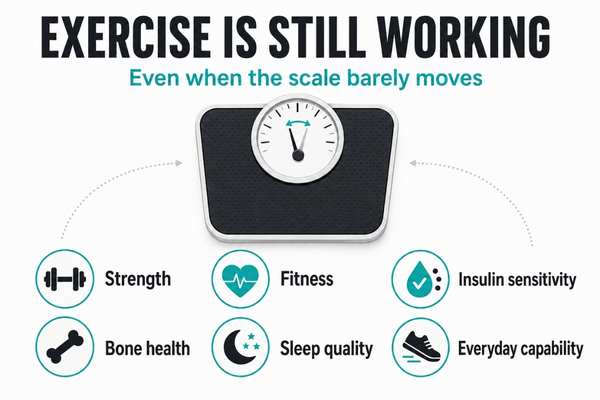
Your training is working, even if the scales say otherwise. A large 2024 analysis pooling 116 randomised trials of aerobic exercise found real, measurable reductions in weight, waist circumference and body fat. But the effect was modest at typical exercise volumes and only became clinically meaningful at higher weekly durations, somewhere around 150 minutes or more of moderate to vigorous activity a week. Each extra 30 minutes a week was linked to roughly half a kilogram off body weight and a similar reduction in waist circumference. That's real. It's also slow, and smaller than most people expect when they first walk into a gym.
Unless you're training serious weekly volume, exercise alone pulls a fairly small lever on the scales. It pulls a much bigger one on almost everything else: strength, cardiovascular fitness, insulin sensitivity, bone density, sleep quality, and your ability to carry your own shopping in your seventies. None of that shows up on the scales. Which is exactly why it gets written off by people judging the whole programme on one number.
Why nutrition is the direct lever
Fat loss happens when you consistently take in less energy than you use. Exercise increases the "use" side, but for most people it increases it by less than they think, and the body has an annoying habit of clawing some of it back without you noticing. You move a bit less elsewhere in the day, or eat a bit more without registering it. Nutrition acts directly on the intake side of the equation. What you eat sets your intake, and it's a far more controllable, far more immediate lever than trying to out train a bad diet.
The research backs this up. A meta-analysis comparing diet only, exercise only and combined programmes found combined diet and exercise produced significantly greater weight loss than exercise alone at every point they measured, roughly 5kg more at three to six months, and over 6kg more at twelve to eighteen months. Of the three, exercise alone was consistently the weakest lever for the number on the scales, while still being essential for the things a diet can't give you: strength, muscle retention and long term body composition.
That's not a reason for you to skip the gym. It's a reason to stop blaming the gym when your nutrition hasn't actually changed.
Where sleep and stress actually fit in
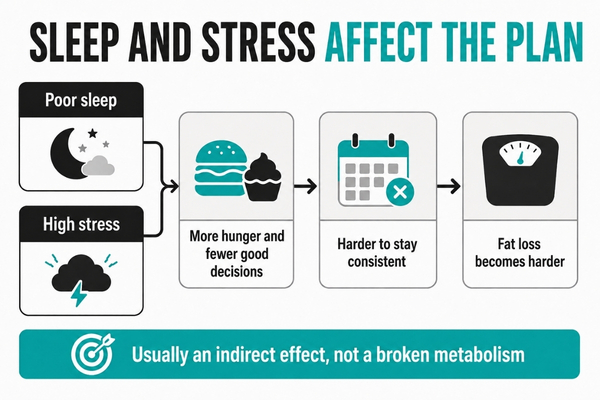
Sleep and stress don't block fat loss the way people sometimes assume. They work indirectly, mostly through your appetite and your ability to stick to a plan. Controlled studies have found that partial sleep restriction can increase energy intake without a corresponding increase in energy expenditure. A meta-analysis of 11 studies estimated an average increase of approximately 385 calories a day. The precise hormonal mechanisms remain debated, but the behavioural pattern is clearer: tired people often eat more and find it harder to regulate their intake.
Chronic stress works in a similar way. For the vast majority of people it isn't switching off fat loss at a cellular level. What it does is make the plan harder to follow. Less headspace for meal prep, more reaching for whatever's quickest, sleep taking a hit on top, and less appetite for the discipline a deficit needs when everything else already feels like hard work. Poor sleep and high stress are real and worth taking seriously, but as things that wear down your adherence, not as some separate switch that makes fat loss impossible whatever you eat.
The pattern I see constantly
Here's the part the ten point checklists never get into, because it isn't physiology. It's behaviour, and it's the thing I watch play out with nearly every new client whose main goal is fat loss.
Training is the part of the plan with a fixed appointment. Someone else runs the session, the diary decides when it happens, and turning up is most of the job. Nutrition, sleep and stress management don't work like that. They need decisions made at the supermarket, on a Tuesday evening after a long day, in a hundred small moments nobody else is watching. It's no great surprise training gets sorted first and everything else lags behind. One only asks you to show up once or twice a week. The other asks you to show up to yourself, constantly.
So people get stronger. They get fitter. Resting heart rate improves, lifts go up, and the fat loss they actually came in for barely shifts. And they conclude, reasonably enough from where they're standing, that the exercise "isn't working."
I often work with people whose primary goal is fat loss, but nutrition is the part they're least ready to address. We can talk it through, simplify it and agree practical changes, but sometimes it takes weeks or months before those changes become consistent. Then, to nobody's surprise except perhaps the client's, their measurements start moving and they begin feeling better. That's usually where the real momentum kicks in, because once someone's sleeping and eating a bit better, exercise gets easier to show up for too, and the whole thing starts reinforcing itself instead of fighting itself.
What to actually do about it
If this sounds like where you are, the fix isn't more cardio, and it isn't beating yourself up over willpower. It's being honest about which part of the plan has genuinely been consistent.
Keep the training. It's protecting the muscle and fitness you'll need regardless of what the scales say, and it's doing more for your long term health than any single number ever will. But have a proper look at what you're eating across a normal week, not just the days that go to plan. Get your sleep somewhere reasonable before you try to fix everything else at once. It's one of the cheapest, lowest effort levers you've got, and it makes the rest of the plan easier rather than harder. And if stress is genuinely relentless right now, that's a conversation about protecting a handful of non negotiables, sleep, one proper meal, a walk, rather than trying to run a perfect plan on top of an imperfect week.
None of that is a criticism of the training you've already been doing. It's usually just the first honest place to look when the rest of the picture hasn't had the same attention.
The next step
If you've been putting the work in at the gym and want an honest look at what's actually driving, or stalling, your results, that's exactly the conversation I have in a free consultation at Lightwater Leisure Centre. No workout, no pressure, just a proper look at training, nutrition, sleep and where the real leverage is for you.
You might also find Why Busy Professionals Neglect Their Health After 40 useful, particularly if training is the only part of your health plan that consistently makes it into the diary.
Book a free consultation at edefitness.com/booknow, or email me directly at [email protected].
Rob Ede is a health first personal trainer and Level 4 nutrition coach at Lightwater Leisure Centre, working with busy professionals aged 40 to 60 across Lightwater, Bagshot, Windlesham and Surrey Heath.
Medical disclaimer: This article is for general information and education only and is not a substitute for personalised medical advice, diagnosis or treatment. I am a qualified personal trainer and nutrition coach, not a doctor. Always consult an appropriate healthcare professional before making significant changes to your exercise, nutrition or medication, particularly if you have a medical condition, are pregnant, or take prescription medication.
Related reading
How Much Exercise Do You Actually Need After 50?
Why You're Getting Weaker After 50, and Why It's Not Inevitable
References (for the curious)
Jayedi A, et al. Aerobic Exercise and Weight Loss in Adults: A Systematic Review and Dose-Response Meta-Analysis. JAMA Network Open, 2024;7(12):e2452185. (116 RCTs; each 30 min/week of aerobic exercise associated with ~0.52 kg body weight and ~0.56 cm waist circumference reduction; ~150 min/week needed for clinically meaningful body fat reduction)
Johns DJ, Hartmann-Boyce J, Jebb SA, Aveyard P. Diet or Exercise Interventions vs Combined Behavioral Weight Management Programs. Journal of the Academy of Nutrition and Dietetics, 2014;114(10):1557-1568. (Combined diet-and-exercise programmes produced significantly greater weight loss than exercise alone at 3-6 and 12-18 months)
Al Khatib HK, et al. The Effects of Partial Sleep Deprivation on Energy Balance: A Systematic Review and Meta-Analysis. European Journal of Clinical Nutrition, 2017;71(5):614-624. (Partial sleep deprivation increased energy intake by an average of approximately 385 calories a day without significantly affecting energy expenditure)
Copyright © 2026 Rob Ede. You may quote brief excerpts from this article provided you include appropriate attribution and a link to the original. Please do not reproduce or republish the article in full without written permission.