Why You're Getting Weaker After 50, and Why It's Not Inevitable
You notice it in small things first. Hauling yourself off a low sofa with a hand on the armrest. Taking the station stairs a touch slower than you used to. A suitcase into the overhead locker that feels heavier than the same case did five years ago. Nobody hands you a diagnosis. You quietly file it under "getting older" and carry on.
Here's the problem with that. Most of what you're feeling isn't the unavoidable tax of age. It's a specific, measurable, and largely reversible loss of strength, and the story you've been told about it is mostly wrong. That wrong story costs people years of needless decline, because if you think decay is just the weather, you stop trying to change it.
There's a name for it, and it's not "old age"
The condition is sarcopenia: age-related loss of muscle and strength. And in 2019 the European consensus group did something that matters. They reclassified it from an inevitable feature of ageing into a recognised muscle disease, with its own diagnostic code. The shift isn't just paperwork. It moves the whole thing from "nothing to be done" to "treatable problem with a known fix."
The other thing they changed: strength, not size, is now the primary marker. That reflects how the decline works. After about 50, you lose muscle mass at roughly 1 to 2% a year. But strength goes faster, around 1.5% a year through your fifties and closer to 3% a year after that. Across studies that measure both in the same people, strength is lost two to five times quicker than mass.
Why does strength fade faster than the muscle itself? Because the wiring goes before the tissue does. The connections between nerve and muscle, the system that fires a muscle into action, start to drop out years before you'd notice anything shrinking in the mirror. It's a software problem before it's a hardware one. That's why you feel weaker and slower well before you look any different, and why power, the ability to move quickly with force, is the first thing to go.
This matters for what you do about it. That wiring responds to challenging load, not gentle pottering about. Properly demanding, progressive resistance training is the most effective stimulus we have for recruiting and rebuilding those high-threshold connections. Gentler movement doesn't get near them.
It starts at 45, not 65
The common assumption is that this is a problem for your seventies. It isn't. The decline is well underway in mid-life, and the modern professional lifestyle pours petrol on it.
Three accelerants do most of the damage. Chronic desk work strips out the baseline movement that keeps muscle ticking over. A lack of any real resistance training tells the body that muscle is expensive tissue it doesn't need, so it sheds it. And busy, protein-light eating fails to trigger the repair process that holds muscle together. Whether you're commuting out of Bagshot before dawn or running a business in Windlesham, that's a near-perfect setup for losing strength quietly through your forties and fifties. The front line of this problem is mid-life, not retirement.
Why it's worth taking seriously
Not to frighten you. The point is the opposite: this is one of the highest-return things you can act on, and it responds at any age. But the stakes are real, so let's be straight about them.
Grip strength is the clearest window. In the PURE study, which tracked nearly 140,000 people across 17 countries, every 5kg drop in grip strength was linked to about a 16% higher risk of dying from any cause. It predicted mortality better than blood pressure did. Grip itself isn't magic; it's a reliable proxy for how strong your whole body is. A weakening grip is your body's strength telling on itself.
There's a metabolic cost too. Muscle is the main place you dispose of the glucose from your food. Lose it, and insulin resistance and visceral fat tend to creep up together. The softening middle and the fading strength aren't two separate midlife problems. They're often the same one.
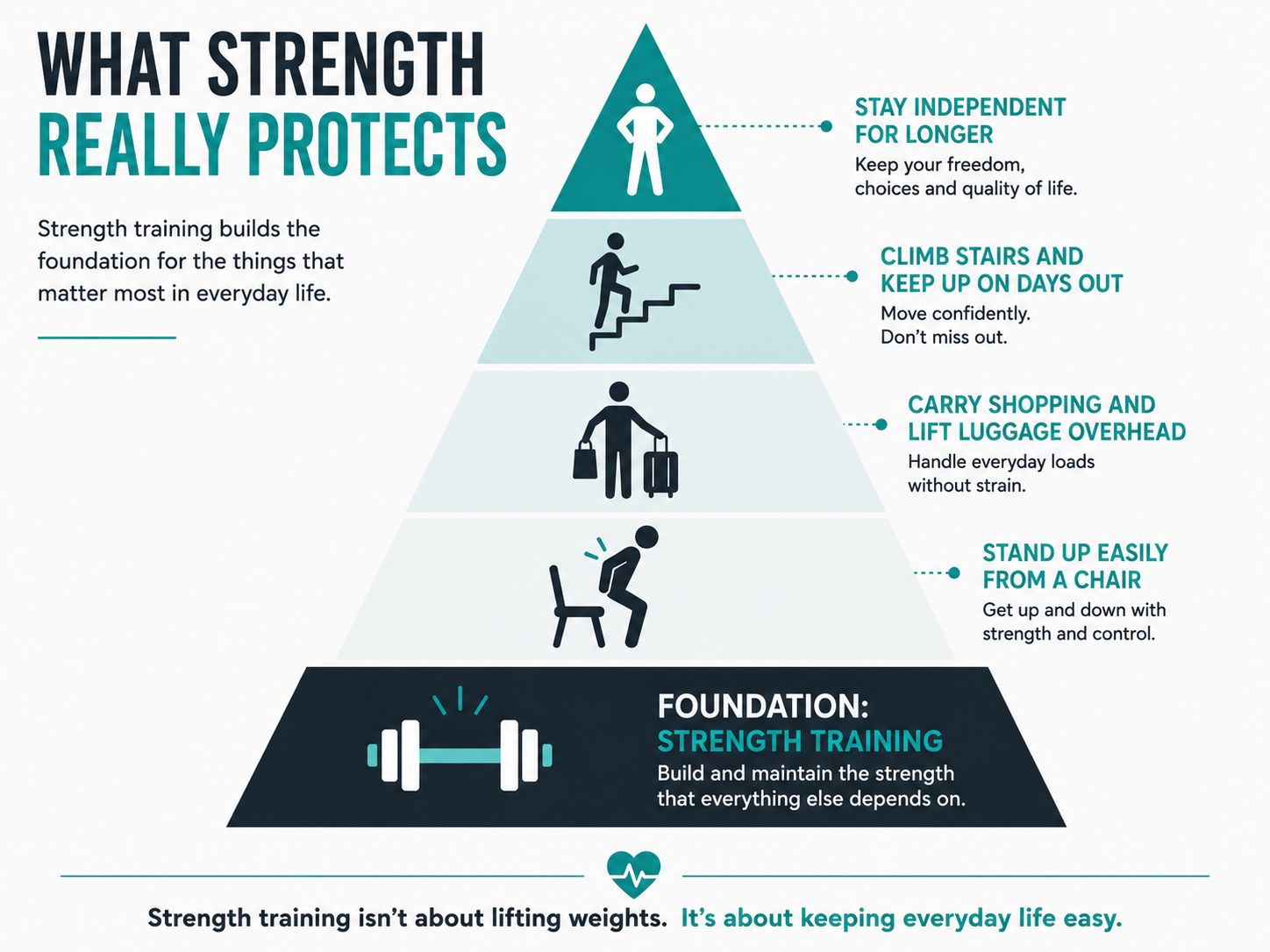
And then the obvious, human stuff: the "save" when you trip, getting off the floor unaided, keeping up on a weekend away, lifting a grandchild without a second thought. That's what strength protects.
"But I walk every day"
Good. Keep walking, it's excellent for you. But walking won't fix this, and it's important to understand why, because it's the single most common thing I hear.
Walking is a result of muscle health, not a stimulus for it. It uses the strength you've still got; it doesn't rebuild the strength you've lost. The connections that decay first are the high-threshold ones, and a stroll never asks for them. "Light weights for toning" has the same flaw: too light to recruit what matters. Toning is just muscle you can see, and you get there through actual strength, not pink dumbbells.
As for "lifting's dangerous at my age", the far bigger danger is weakness. It's weakness that puts people on the floor and into A&E, not well-coached, progressively loaded training. Done properly, strength work is one of the safest and most protective things you can do, joints included.
Two quick checks you can do at home. Stand up from a dining chair five times without using your hands, and time it: much over 15 seconds is worth acting on. And pay attention to your grip on jars and shopping bags. These aren't diagnoses, just early warning signals. If something feels off, mention it to your GP.
What this looks like when someone actually does it
People think the barrier to starting is physical. Usually it's in your head. Tracy came to me at 59, after a long stretch of doing very little, and she'll tell you straight that she's not a natural gym person:
"Starting the fitness process at the age of 59 after not doing much movement for a long time was quite scary, and perhaps a huge hurdle to overcome in my head. To be honest, I'm not a gym fan. Rob has introduced me to the gym in a way that makes it more interesting, and I'm doing routines that I never dreamed I would or could do. Rob has helped me become stronger, and my knee pain, that I was experiencing most of the time before I started, has reduced by about 70%, and going up and down stairs is much easier. The process has made me mentally stronger as well as physically stronger, and I appreciate that Rob pushes me, but not in a way that makes me not want to go back."
Note what changed there. Not a beach body: easier stairs, less knee pain, and the confidence that comes with both. That's strength doing its real job, making ordinary life feel manageable again. And she started at 59, having not exercised in years, which is precisely the point. Meaningful strength gains are possible into your eighties and nineties. Clinically, the idea that you've left it too late doesn't hold up.
What actually moves the needle
For a time-poor professional, the honest hierarchy is short.
Resistance training, progressively loaded, is the gold standard, because it's the one approach that reliably trains both the wiring and the tissue. Two full-body sessions a week is the minimum effective dose, built around compound movements: a squat, a press, a pull, a hinge. That two-sessions-a-week structure is the whole basis of how I run PrimeFit at Lightwater Leisure Centre, getting the most out of the limited training time you can realistically commit.
Protein comes next: aim for around 1.2 to 1.5g per kg of bodyweight a day, spread across three or four meals rather than dumped into one. Older muscle is slightly deaf to protein, so the size and spacing of each hit matters more than it did at 30. Sleep is where the repair happens. And creatine and a daily step count help round it off, but they support the lifting; they don't replace it.
The unglamorous truth is that it's two sessions a week, lifted with intent, sustained for months. That's the price. The return is staying strong, capable and independent for a couple of decades longer than the people who filed it all under "getting older."
Where coaching comes in
None of the science above is in dispute. The gap is never information. It's doing the right thing consistently, with load that's heavy enough to count but matched honestly to where you're starting from. That's the hard part to self-manage, and it's the part Tracy would tell you made the difference: someone to make it interesting, push you sensibly, and keep you wanting to come back.
If your weakness also comes with a painful joint that needs hands-on assessment first, I work alongside Physica Health in Bagshot, a Masters-qualified physiotherapy clinic, for exactly that. Strength work and skilled rehab are two halves of the same job, not rivals.
If you're in Lightwater, Bagshot, Windlesham or anywhere across Surrey Heath and you've started noticing the small signs, book a diagnostic consultation with me at Lightwater Leisure Centre and we'll map out a strength-and-longevity plan around your schedule and your real starting point. Head to edefitness.com or email me directly at [email protected].
You're not too old to start, and you're not too far gone to change it. The decline is real, but it isn't a one-way street.
You may also find this useful:
Creatine After 40: The Evidence — the cheap, well-studied supplement that supports the strength work above.
How to Lower the Odds of a Hip Replacement, and Come Through One Faster If You Need It — the same "it's not inevitable" logic, applied to the hip.
References (for the curious)
Cruz-Jentoft AJ, et al. (2019). Sarcopenia: revised European consensus on definition and diagnosis (EWGSOP2). Age and Ageing, 48(1), 16–31.
An overview of sarcopenia: facts and numbers on prevalence and clinical impact — annual rates of muscle and strength loss after 50.
Sarcopenia, dynapenia, and the impact of advancing age on human skeletal muscle size and strength — strength lost 2–5x faster than mass, and a stronger predictor of disability and death.
Prognostic value of grip strength (PURE study) — The Lancet, 2015. Each 5kg fall in grip strength linked to ~16% higher all-cause mortality.
Association of muscle strength with all-cause mortality in the oldest old — Journal of Cachexia, Sarcopenia and Muscle, 2024. Resistance training improves strength even in frail nonagenarians.