How to Lower the Odds of a Replacement — and Come Through One Faster If You Need It
If you're in your 40s, 50s or 60s and you've started noticing a deep ache in the groin or a stiffness getting out of the car after the commute back from London, somebody has probably already used the phrase "wear and tear" at you. The implication is that your hip is a set of brake pads. They're worn, you've done the miles, and a replacement is just a matter of time.
That framing is mostly wrong, and it costs people years of unnecessary decline. So let's deal with the evidence properly — because the picture is more useful and more in your control than "wait until it's bad enough to operate."
Two things are true at once. A hip replacement is not inevitable for most people with hip pain. And if you do end up needing one, how strong you are going into theatre — and what you do afterwards — has a real effect on how you come out. Both of those levers are yours to pull.

First, the scale of it — and why that's not a reason to be fatalistic
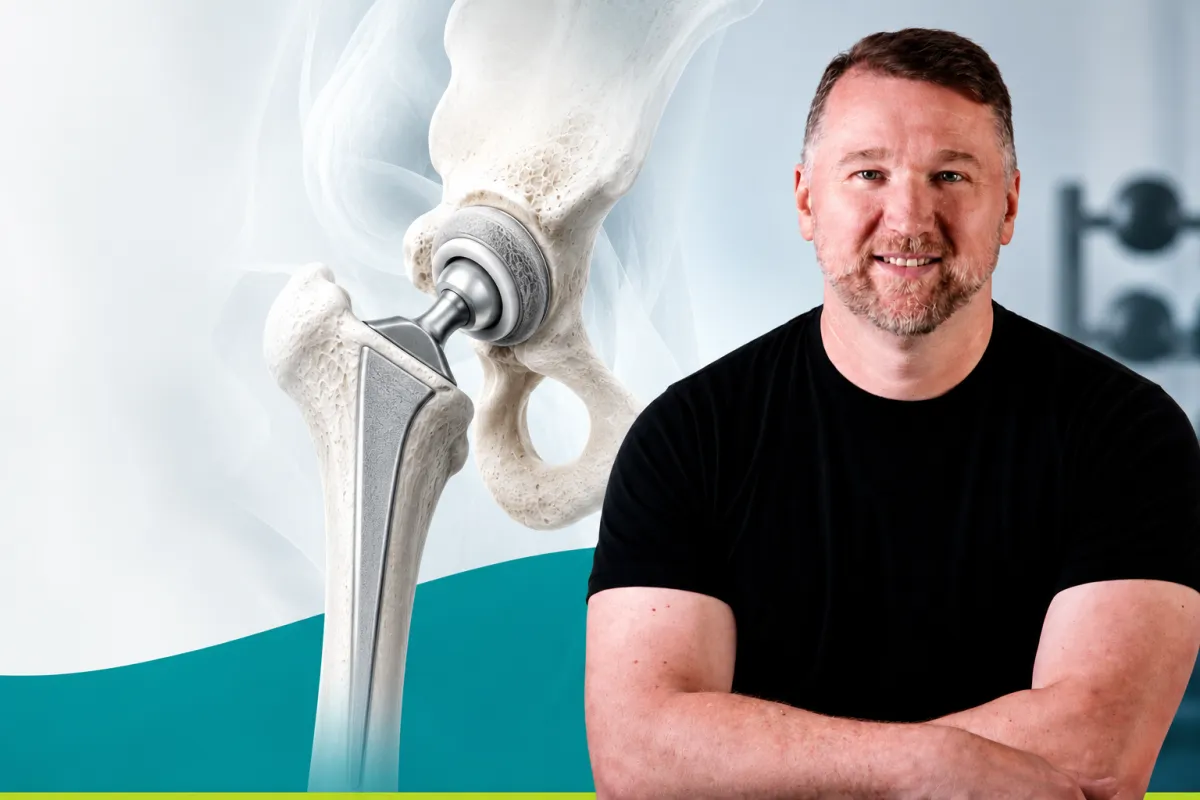
Hip replacement is one of the most common and most successful operations the NHS does. There are roughly 85,000 to 95,000 primary hip replacements a year across the UK, the average patient is about 70, and osteoarthritis is by far the most common reason. The procedure has a genuinely excellent track record — large, lasting improvements in pain and function for most people who have one.
None of that means it's your destiny. The average age tells you something important: this is largely a problem of the back half of life, and the back half of life is exactly where the modifiable factors — your weight, your strength, your activity — compound the hardest. The numbers are rising mainly because the population is ageing, not because hips have suddenly become more fragile.
"Not inevitable" — what's actually in your control
Here's the part the "wear and tear" story leaves out. Osteoarthritis isn't a simple mileage problem. Some risk factors you can't touch: your age, your sex (women have hip replacements more often than men), your genetics, the shape of the hip you were born with, and old injuries. Be honest with yourself about those — no amount of training rewrites them.
But the single biggest modifiable risk factor sits right in front of you: body weight. The link between obesity and hip osteoarthritis isn't just correlation — Mendelian randomisation studies (which use genetics to test cause and effect) point to weight causing increased OA risk, and the effect is more pronounced in weight-bearing joints like the hip than in the hands. It works two ways. Mechanically, every extra kilo multiplies the load through the joint with every step. Metabolically, excess fat tissue drives low-grade inflammation that degrades the joint from the inside.
The flip side is the encouraging bit. Load reduction is dramatic per unit of weight: shedding weight cuts the force going through the joint with every stride, many times over. In the long-running Framingham study, women who lost around 5 kg roughly halved their risk of developing symptomatic knee OA over a decade. That's knee data, but the mechanism — less load, less inflammation — applies squarely to the hip.
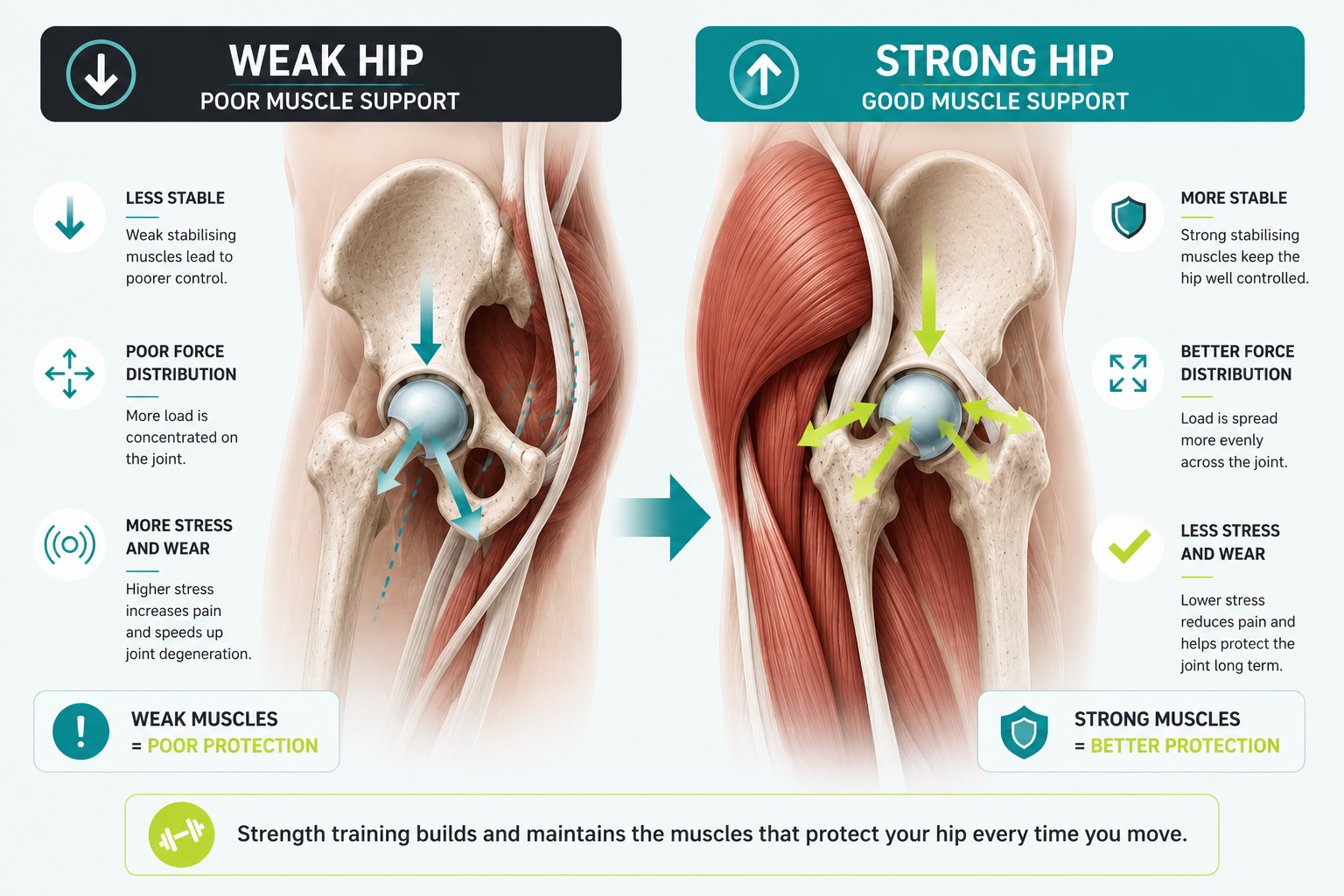
And there's a second lever that gets ignored: muscle. A weak, deconditioned hip is a poorly protected hip. The muscles around the joint — glutes, quads, the deep stabilisers — are what control how force is distributed every time you stand, walk or climb stairs. Let those waste away through midlife (sarcopenia takes roughly 1% of your muscle a year after 50 if you do nothing about it) and you hand the joint a harder job. Build and keep them, and you're actively defending the hip.
There's no drug that reverses osteoarthritis. None. That's not a gap to wait out — it's the whole reason the modifiable factors matter so much. Weight and strength aren't the consolation prize while you wait for medicine to catch up. They are the treatment.
If you've already got hip pain: exercise is the front-line treatment, not the fallback
This is where people get it backwards. They treat exercise as the thing you try while you're on the waiting list — when actually it's the first-line, evidence-graded treatment for hip OA.
The 2025 international Clinical Practice Guideline for hip osteoarthritis gives exercise therapy its top grade as the primary intervention: individualised strengthening and mobility work, done consistently over a few months. Weight management and appropriate use of anti-inflammatories alongside it. The honest caveat — and this matters, because overselling it is exactly the fluff this audience tunes out — is that for the hip specifically, the average benefit of exercise on pain and function is small to moderate, not miraculous. It won't regrow cartilage. What it does is reduce pain, improve how well you move, and keep you off the operating table longer — sometimes for years, sometimes indefinitely.
For a busy professional, the practical version isn't an hour of fiddly clamshells every day. It's two or three properly structured strength sessions a week, progressively loaded, built around the hip and the muscles that protect it. That's the whole basis of how I run PrimeFit at Lightwater Leisure Centre — getting the maximum return out of the limited training time you can realistically commit.
A word on the structural side. If your pain has a clear mechanical or biomechanical driver — a gait issue, an old injury, something that needs hands-on assessment — that's worth a proper physio's eyes, not just a training programme. I work with Physica Health in Bagshot, a Masters-qualified physiotherapy clinic, for exactly that. Strength training and skilled rehab aren't competitors; they're two halves of the same job.
If you do need the operation: go in strong, come out faster
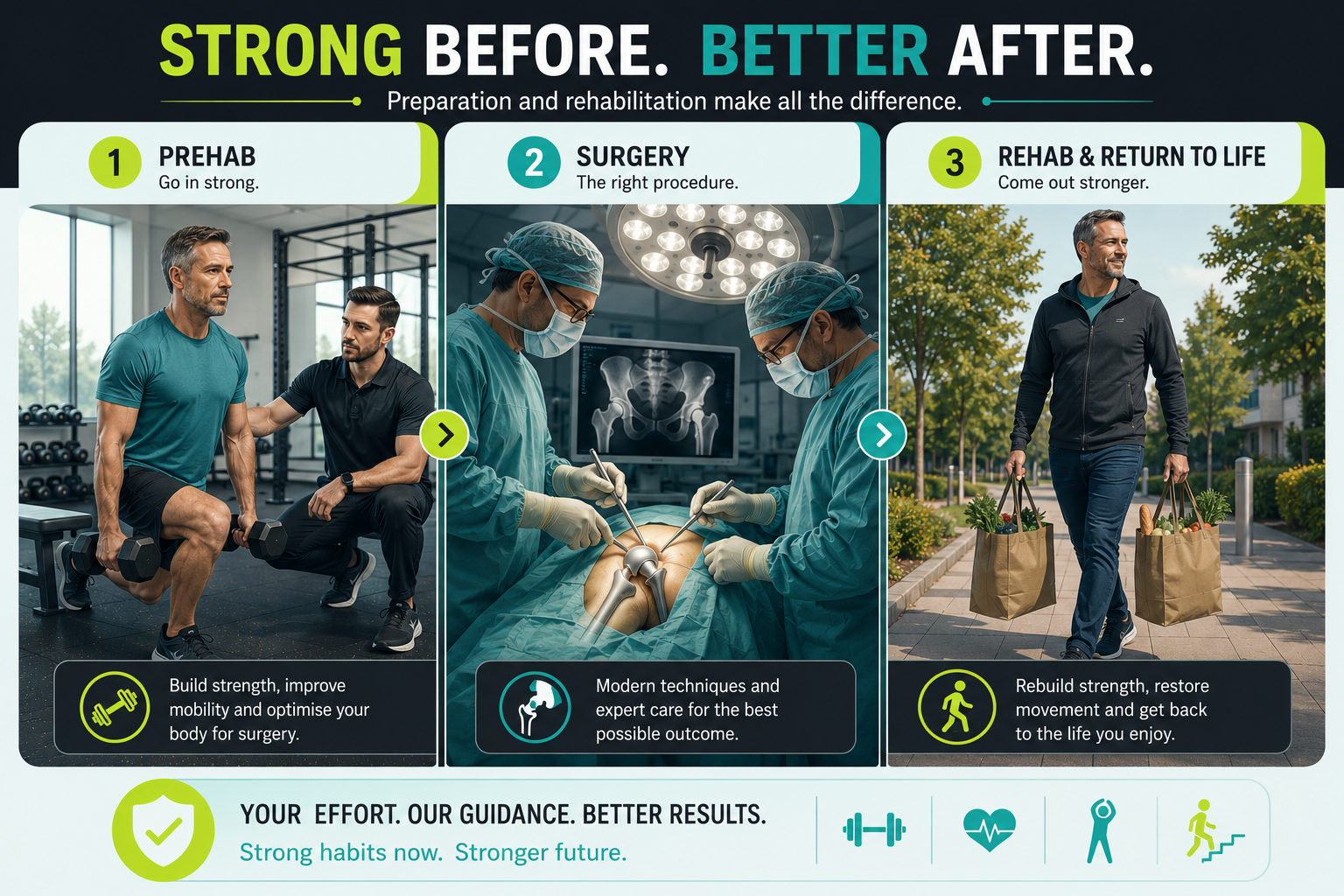
Sometimes the joint is genuinely done, and surgery is the right call. If you reach that point, the worst thing you can do is shut down and wait it out — because the evidence on "prehabilitation" (training before surgery) is genuinely interesting, and worth getting right rather than romanticising.
Here's the honest read. The picture is mixed, and I'm not going to pretend otherwise. Overviews of the research find prehab — particularly progressive resistance training — tends to improve your strength and function going into surgery, can reduce complications, and improves quality of life beforehand. Some reviews show faster early recovery. But a good 2025 Norwegian trial in over-70s found that 6–12 weeks of prehab didn't beat usual care on outcomes three months after surgery — both groups did well, because the operation itself is so effective. So the realistic claim isn't "prehab guarantees a better hip a year later." It's this: you walk into theatre fitter, stronger and more mobile, you're better protected against complications, and you give yourself the best possible launchpad for recovery. Given that around one in five people report a less-than-ideal result after joint replacement — often lingering weakness rather than a failed implant — that launchpad is worth having.
The part with the strongest case is what comes after. Surgery replaces the joint; it does not replace the muscle. Strength around the operated hip frequently stays below that of healthy, same-age adults for years post-op if nobody deliberately rebuilds it. Progressive resistance training is what closes that gap and turns "I can walk without pain" into "I can carry the shopping, get off the floor, and keep up on a weekend away." Don't stop at the point the NHS physio discharges you — that's the floor, not the finish line.
The bottom line
A hip replacement isn't a foregone conclusion, and it isn't the end of being capable. Keep your weight in a sensible range, build and defend the muscle around the joint, and you measurably shift the odds away from surgery. If you still need it, arrive strong and rebuild properly afterwards, and you stack the deck in your favour at both ends.
If you're in Lightwater, Bagshot, Windlesham or anywhere across Surrey Heath and your hip has started talking to you — whether you're trying to avoid surgery, preparing for it, or rebuilding after one — that's exactly the kind of problem a structured plan solves. Book a diagnostic consultation with me at Lightwater Leisure Centre and we'll map out a strength-and-longevity plan built around your hip and your schedule. Head to edefitness.com or email me directly at [email protected].
Your hip's future is more negotiable than anyone's told you. Let's get to work on it.
References (for the curious)
Koc et al. (2025). Hip Osteoarthritis: Clinical Practice Guideline. Journal of Orthopaedic & Sports Physical Therapy. (Exercise therapy graded as primary intervention.) https://www.jospt.org/
Teirlinck et al. (2024). Effect of exercise therapy in patients with hip osteoarthritis: a systematic review and cumulative meta-analysis. Osteoarthritis and Cartilage Open. https://pmc.ncbi.nlm.nih.gov/articles/PMC9932106/
The Critical Role of Physical Activity and Weight Management in Knee and Hip Osteoarthritis (2024). The Journal of Rheumatology. https://www.jrheum.org/content/51/3/224
Genetically predicted obesity and risk of hip osteoarthritis (Mendelian randomisation). https://www.ncbi.nlm.nih.gov/pmc/articles/PMC9931853/
The Effects of Structured Prehabilitation on Postoperative Outcomes Following Total Hip and Total Knee Arthroplasty (2025). JOSPT. https://www.jospt.org/doi/10.2519/jospt.2025.13075
Resistance Training Prior to Total Hip or Knee Replacement and Postoperative Recovery (meta-analysis). https://www.ncbi.nlm.nih.gov/pmc/articles/PMC9329591/
Prehabilitation for older patients awaiting total hip replacement: an RCT with long-term follow-up (2025). BMC Musculoskeletal Disorders. https://link.springer.com/article/10.1186/s12891-025-08468-4
National Joint Registry / NHS PROMs — UK hip replacement volumes and outcomes. https://www.njrcentre.org.uk/