Why Busy Professionals Neglect Their Health After 40
You can run a department, a P&L, or a global account. You can hit targets year after year. And yet the one asset everything else depends on — your own body — is the one you've quietly let slide.
It's a strange pattern, and I see it constantly with people who come to me in their forties and fifties. The more capable someone is at managing complexity at work, the more likely they are to be neglecting the basics of their own physical health. Not through laziness. Through the exact discipline and prioritisation that made them successful in the first place. Everything got managed except the thing that makes the rest possible.
If that lands a bit close to home, the rest of this is for you. No lecture, no hype — just what's actually happening under the bonnet, and what a realistic fix looks like for someone whose diary is already full.
The body is the one KPI you stopped tracking
Here's the uncomfortable bit. You measure everything at work. Revenue, churn, pipeline, deadlines. But somewhere in your thirties, you stopped tracking the one metric that quietly governs your energy, your focus and your healthspan — and the numbers kept moving anyway.
After about 50, you lose roughly 1–2% of your muscle mass every year, and muscle strength goes faster: about 1.5% a year through your fifties, then around 3% a year after that. Left unchecked, that's the slow drift you feel as "I just don't have the energy I used to". It's not your age being mystical. It's a measurable decline that's been compounding while you weren't looking — and like any compounding number, the cost of ignoring it grows the longer you leave it.
That's the real reason this matters. Not vanity. Capability. The ability to carry your own bags through an airport at 60, get off the floor without thinking about it at 70, and keep your independence at 80 is being decided by what you do in this decade.
The structural cost of corporate life
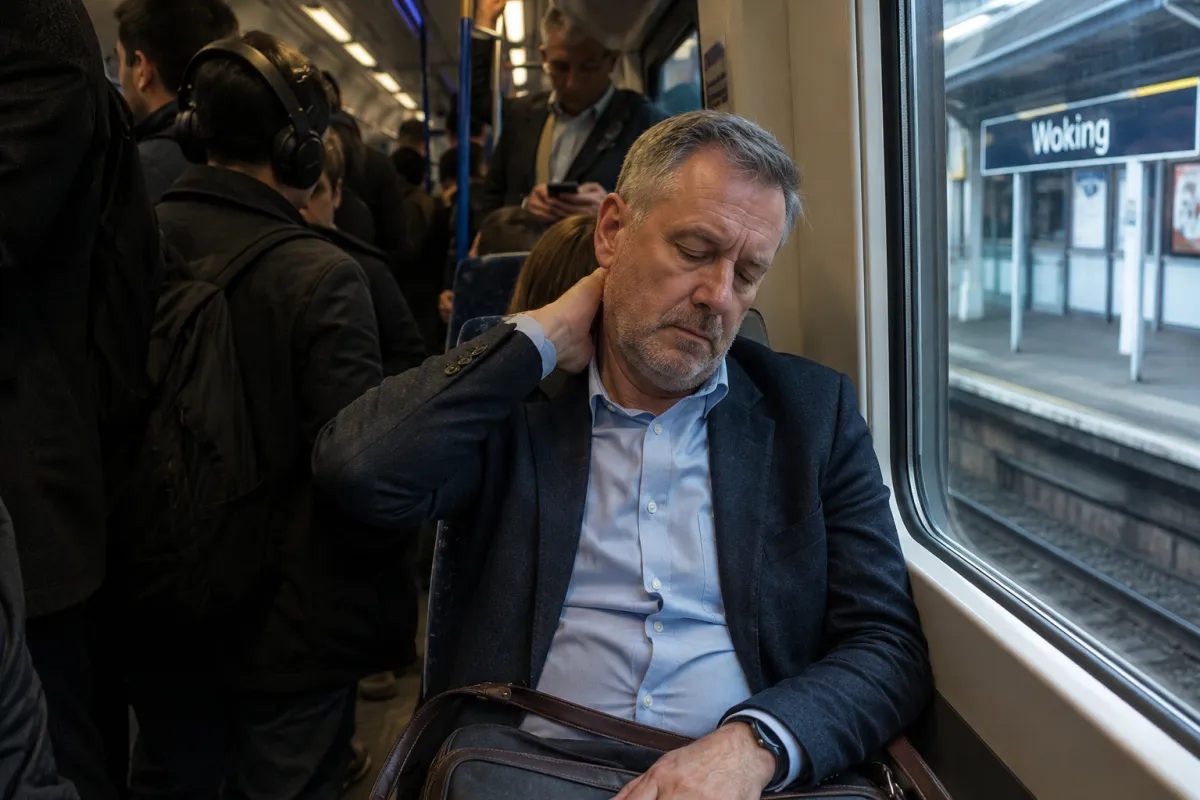
Spend a working life in meetings and on the commute and you accumulate a specific kind of damage. Office workers spend, on average, around 72% of their working hours sitting. Add the train into London or the drive round the M25 and you're looking at a body that's stationary for most of its waking life.
This isn't a soft "sitting is the new smoking" soundbite. A meta-analysis of nearly 450,000 people found that high total daily sitting time was linked to roughly a 29% higher risk of cardiovascular disease and a 13% higher risk of type 2 diabetes — and crucially, that held independently of whether you exercised. Prolonged sitting blunts insulin response, slows fat metabolism and stiffens the whole kinetic chain. The chronic lower-back tightness, the cranky knees, the mid-afternoon fog — that's the bill arriving.
And it's not only the body. The same pressures that make you effective at work — the relentless cognitive load, the constant decisions, the low-grade stress — quietly erode sleep, concentration and recovery, the exact faculties you trade on. Whatever you call "being busy", your nervous system is keeping its own ledger.
Even in an affluent pocket like Surrey Heath, where you'd expect the numbers to be flattering, somewhere between a fifth and a third of adults don't manage even half an hour of moderate activity in a week. Wealth buys a lot of things. It doesn't buy you out of deconditioning.
Why willpower keeps failing you
Successful people often blame themselves for not "being more disciplined" about exercise. That's the wrong diagnosis.
You spend your decision-making capacity all day — judgement calls, prioritisation, managing people. By 7pm there's very little left in the tank. That's not weakness; it's decision fatigue, and it's the predictable result of a demanding role. So you default to all-or-nothing: either a heroic hour you don't have, or nothing. Nothing wins, most nights.
The fix isn't more willpower. It's removing the decisions. The reason a structured, scheduled, supervised approach works for this audience when generic gym advice doesn't is that it takes the planning, the second-guessing and the "what do I do today" entirely off your plate. You turn up, the thinking's already done, you train, you leave. For a decision-fatigued brain, that's the whole game.
"I don't have time" — the objection that costs the most
This is the one I hear more than any other, and I understand it. But it doesn't survive contact with the evidence.
You don't need the gym-rat's five sessions a week. The research is clear that two to three properly structured strength sessions are enough to meaningfully slow muscle loss and rebuild capability — and that 30 to 40 minutes of real activity a day offsets a large chunk of the damage from all that sitting. This is the highest-return, lowest-time-cost lever available to a busy professional, and most people never pull it because they're cynical about an industry that's earned their cynicism.
What you're actually short of isn't time. It's an efficient system that respects it. The hour-long commute to a crowded gym, the locker-room faff, waiting for a rack — that's the inefficiency worth detesting. Two focused sessions a week, close to home, with the programming handled for you, is a rounding error in a professional's diary. The ROI on physical capability is simply better than almost anything else you could do with that half hour.
The myth that you're "too far gone"
Somewhere along the way a lot of successful people quietly decide their body is broken. It isn't. It's deconditioned — and those are very different problems with very different fixes.
Broken implies permanent. Deconditioned just means underused, and underused responds remarkably well to being used again. Without strength training, people can lose up to 30% of their muscle between 50 and 70. With it, you can rebuild muscle and strength at any age — older adults often see proportionally bigger strength gains than younger ones when they start. The decline isn't a one-way street; it's just been running downhill because nobody put a hand on the wheel.
This matters even more for women in midlife. The drop in oestrogen around menopause accelerates muscle and strength loss, which is exactly why the "I'll just do a bit more walking" approach often isn't enough on its own, and why resistance training becomes non-negotiable rather than optional. It's not about getting bulky. It's about not getting frail.
What a realistic fix actually looks like
If you take nothing else from this, take this: you don't need a lifestyle overhaul. You need a small number of high-value habits, done consistently, with the decisions removed.
In practice that means two or three short, structured strength sessions a week, built around the big movements that protect your back, hips and knees. It means breaking up long sitting bouts — standing for calls, walking the long way, a few minutes of movement every hour, which does more than people expect. It means getting protein and sleep roughly right rather than chasing some perfect plan you'll abandon by February. And it means tracking it, because you already know that what gets measured gets managed.
That's it. It's deliberately unglamorous, because the unglamorous version is the one that survives a demanding career.
I spent over a decade in a data-driven corporate world before I did this, so I'll be straight with you: the people who turn this around aren't the ones with the most motivation. They're the ones who stopped relying on motivation and built a system instead. The body is the one account you can't outsource and can't buy back later. Right now it's probably the only thing in your life you're not actively managing — and it's the one holding everything else up.
If you want a hand building that system around a real diary rather than a fantasy one, that's exactly what I do. I run PrimeFit at Lightwater Leisure Centre, working with professionals across Lightwater, Bagshot, Windlesham and the wider Surrey Heath area who are done with generic advice and want a clear, efficient plan for staying strong and capable through midlife. The first step is a straightforward diagnostic consultation — we look at where you actually are and map out what a sensible two-or-three-session-a-week approach would look like for you.
Book a consultation at edefitness.com, or email me directly at [email protected]. No hard sell — just an honest conversation about getting the one KPI that matters back under management.
References (for the curious)
HSE — Working days lost in Great Britain (2024/25: 22.1 million days lost to work-related stress, depression or anxiety)
Sitting Time and Risk of Cardiovascular Disease and Diabetes: A Systematic Review and Meta-Analysis — PubMed
Effects of workplace interventions on sedentary behaviour and physical activity — The Lancet Public Health, 2025 (office workers ~72.5% of working hours sedentary; 30–40 min daily activity offsets much of the risk)
An overview of sarcopenia: facts and numbers on prevalence and clinical impact — PMC (muscle loss 1–2%/yr and strength loss 1.5–3%/yr after 50)
Henry Ford Health — How to maintain muscle mass as you age (up to 30% muscle loss between 50 and 70 without training; rebuilding possible at any age)
University Hospitals — Protecting against age-related muscle loss (oestrogen decline at menopause accelerates muscle and strength loss)
Custom HTML/CSS/JAVASCRIPT
You might also find these useful
The Structural Cost of a Corporate Career
How years behind a desk quietly reshape your body and what you can do to reverse the damage.
Is a Personal Trainer Worth It After 50? Here's What You're Really Paying For
Why the real value of coaching isn't motivation, it's having the right plan when your body starts changing.
Why "Eat Less, Move More" Fails the High-Stress Professional