How Much Exercise Do You Actually Need After 50?
The honest answer is less time than you fear, but not less effort.
If you're in your fifties or sixties and you've quietly stopped doing anything structured, it's rarely because you don't care. It's because the picture in your head — an hour in a gym, five times a week, sweating next to people half your age — doesn't fit a sixty-hour week and a commute. So you do nothing, and a small voice tells you you're slipping. That voice isn't wrong about the slipping. It's wrong about the hour.
Here's the part nobody selling you a transformation wants to say plainly: the amount of exercise that actually protects your strength, your independence and your brain through midlife is smaller than you think. The catch is that it has to be the right exercise, done at the right intensity. Get that straight and the time barrier mostly disappears.
What the guidelines actually ask for
The UK Chief Medical Officers' guidance is unambiguous and, frankly, modest: 150 minutes of moderate activity a week (brisk walking counts), or 75 minutes of vigorous activity (anything that leaves you too breathless to talk in sentences), plus muscle-strengthening work on at least two days a week. That's the floor for any adult.
After 50, one half of that prescription stops being optional. The strength half. The CMOs are explicit that strength training matters specifically because muscle and bone density start their natural decline from around age 50, and that decline is what eventually steals people's ability to do ordinary things — climb stairs, carry shopping, get off the floor.
And here's the gap that should bother you: around two-thirds of UK adults hit the aerobic target, but fewer than a quarter meet the twice-weekly strength guideline — and women and the over-50s are least likely of all. Most people are doing the easy, visible half and skipping the half that actually ages well. It's the most under-prescribed, over-ignored part of the guidance — and for your age group, it's the part that counts most.
The decline you can't walk off
This is where the stakes get concrete. From midlife, you lose somewhere between 0.5% and 1% of your muscle mass every year. Strength goes faster — research summarised by Dr Susan Ratay at University Hospitals puts it at 1.5% to 5% a year after 50. Between 65 and 80, muscle loss can hit 8% per decade. For women, the loss of estradiol through menopause accelerates the whole process, hitting muscle, strength and bone at once.
None of that is reversed by walking. Walking is wonderful and you should do it — but it's a baseline for staying alive, not a tool for rebuilding what's quietly draining away. Resistance training is the only first-line lever that actually rebuilds muscle and signals bone to stay dense. Protein helps, but you can't eat your way out of muscle loss without loading the muscle. That's not opinion; it's the mechanism.
Intensity is the time hack
This is the bit that frees up your calendar. For both bone and metabolic health, intensity does more than duration — which means the way out of the time problem isn't more hours, it's harder, smarter minutes.
The clearest evidence comes from the LIFTMOR trial. Postmenopausal women — average age 65, all with low bone mass — did just two supervised 30-minute sessions a week of heavy resistance and impact training: five sets of five reps at over 85% of their one-rep max. Eight months later, their spine bone density had improved while the low-intensity control group's went backwards, and their strength and balance scores rose with it. Two half-hours a week. Heavy, but brief.
Cardio works the same way. Seventy-five minutes of genuinely vigorous activity across a whole week delivers what 150 minutes of gentle pottering does — so if you're time-poor, trading duration for intensity is simply the better trade. Three or four short, hard efforts beat an hour of ambling you didn't enjoy and won't repeat.
There's a professional payoff too. A large 2026 trial found that a five-minute movement break each hour offsets some of the harm of prolonged sitting, and the hourly cadence was the one people actually stuck to. It won't make you fitter on its own — but for anyone chained to a desk between Bagshot and a London office, it's a free, no-downside way to break up the eleven-plus hours of daily sitting that quietly works against everything else. If you suspect your desk has already left its mark, these five self-tests will show you where you stand.
"I genuinely don't have time"
Let's meet the real objection, because it's the one that stops most people in Surrey Heath from starting. When you add it up — two 30-minute strength sessions and a couple of short vigorous efforts — you're looking at under two and a half hours a week. That's less than a single episode-binge on a Sunday evening. The "I don't have time" wall is, far more often, a scheduling and decision-fatigue problem dressed up as a time problem. You're not short of minutes. You're short of a plan you don't have to think about.
That's a fixable problem, and a much smaller one than it feels.
Four myths worth dropping
"Walking 10,000 steps is enough." Steps are good for you, but ten thousand slow ones do almost nothing for the muscle and bone you're losing. Useful floor; useless ceiling.
"Stay in the fat-burning zone." Gentle, steady cardio burns a higher percentage of fat but fewer total calories, and it leaves your metabolism flat the moment you stop. Harder efforts burn more overall and keep working afterwards. The "zone" is a heart-rate-monitor marketing line, not a weight-loss strategy.
"Heavy lifting is dangerous for ageing joints." This is the one that keeps people lifting pink dumbbells forever. In LIFTMOR, women in their sixties with diagnosed low bone mass lifted at over 85% of their max under supervision — and it proved safe and well tolerated. Done with proper technique and progression, load is what protects joints and bone. The danger is sitting still.
"It's too late to start after 60." Older adults reliably gain real strength from resistance training — the body keeps responding well into later life. The only version of "too late" that's true is the one where you never start.
What to actually do in a normal week
Strip it back to what holds up under a busy life: two structured strength sessions, around 30–40 minutes each, built on a handful of big compound movements loaded properly and progressed over time. Add roughly 75 minutes of vigorous cardio split across the week — short, breathless, done. Stand up and move for five minutes most hours at your desk. That's the whole prescription. It fits inside a working week with room to spare, and it targets the exact things that decline.
The honest complication is that "loaded properly" and "progressed over time" are where it lives or dies. Lifting heavy enough to matter, with technique that holds under load, isn't something most people get right from a YouTube clip — and getting it wrong is how a sensible plan turns into a tweaked back and three months off. That's the real reason to get a coach involved: not motivation, but precision. Doing the right two sessions a week correctly beats guessing at five.
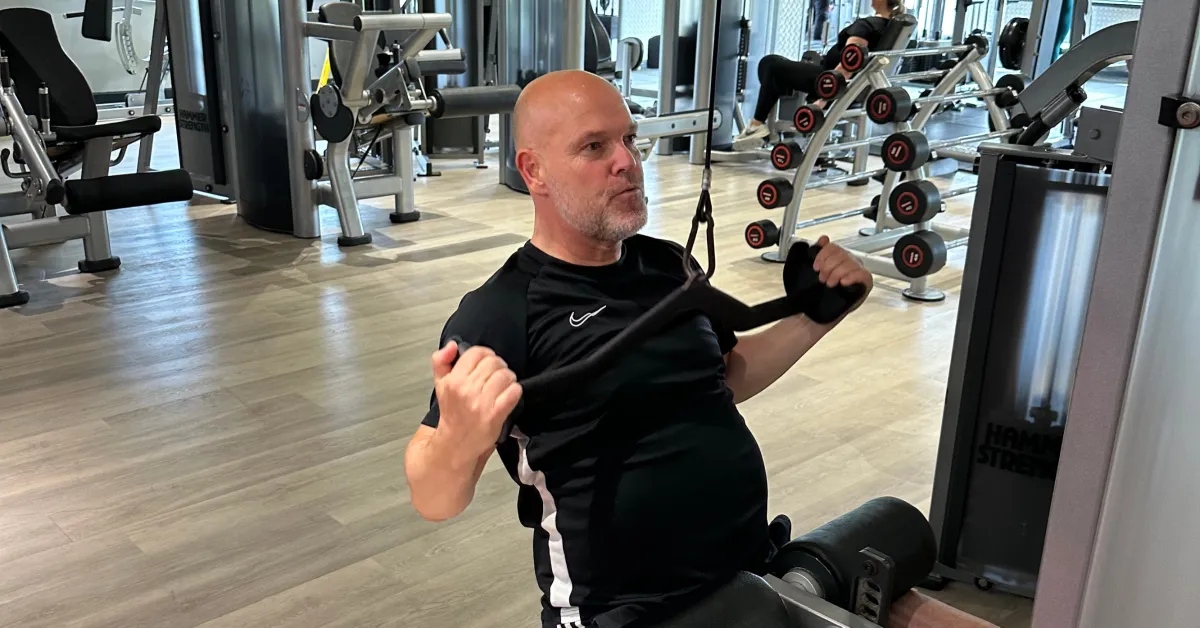
I'm watching this play out with a newer client, Tomasz, who's about six weeks in. The first thing he noticed wasn't a number on a chart — it was simply feeling different. His work is all travelling and meetings, so we're loading muscles his day job never asks anything of. Early on he was very aware of the DOMS, that next-day soreness — but that's rather the point. He's working hard enough, putting the body under enough of the right stress, to actually drive an adaptation. That's what "enough" looks like in practice, and it's a surprisingly hard line to find on your own: heavy enough to change something, controlled enough to stay safe.
If you'd like that mapped out properly for where you are right now — your starting strength, any niggles, the realistic two-and-a-bit hours you can give it — that's exactly what a free intro session is for. I run PrimeFit out of Lightwater Leisure Centre, working with professionals across Lightwater, Bagshot and Windlesham who want the most return from the least time. There's no pressure and nothing to pay: we sit down, look at where you are, and map what staying strong and capable into your sixties would actually take. You can book the free intro session at edefitness.com, or email me directly at [email protected] and we'll talk it through.
The amount you need is smaller than you feared. The cost of doing none of it is bigger than you think. That's the whole case.
Related reading
Is a Personal Trainer Worth It After 50? Here's What You're Really Paying For — the honest case for (and against) getting a coach.
Does Your Desk Job Have a Structural Problem? Five Tests to Find Out — five ten-minute self-checks for the damage sitting does.
References (for the curious)
Watson SL et al. High-Intensity Resistance and Impact Training Improves Bone Mineral Density and Physical Function in Postmenopausal Women With Osteopenia and Osteoporosis: The LIFTMOR Randomized Controlled Trial. J Bone Miner Res, 2018. https://pubmed.ncbi.nlm.nih.gov/28975661/
UK Chief Medical Officers' Physical Activity Guidelines (2019). https://www.gov.uk/government/publications/physical-activity-guidelines-uk-chief-medical-officers-report
NHS — Physical activity guidelines for adults aged 19 to 64. https://www.nhs.uk/live-well/exercise/physical-activity-guidelines-for-adults-aged-19-to-64/
University Hospitals — How to Protect Against Age-Related Muscle Loss (Dr Susan Ratay), 2025. https://www.uhhospitals.org/blog/articles/2025/09/how-to-protect-against-age-related-muscle-loss
Sandercock GR et al. Who is meeting the strengthening physical activity guidelines by definition: a cross-sectional study of 253,423 English adults. PLOS One, 2022. https://journals.plos.org/plosone/article?id=10.1371/journal.pone.0267277
BMJ Group — Hourly movement breaks feasible and effective for mitigating sedentary harms (Body Electric trial), 2026. https://bmjgroup.com/hourly-movement-breaks-feasible-and-effective-for-mitigating-sedentary-harms/