Strength Training With Knee Pain After 40: How to Adapt Your Workouts
Can you strength train with knee pain? In a lot of cases, yes, and for plenty of people over 40 the right kind of strength work turns out to be one of the more useful things they can do for a knee that's been grumbling. The catch is that it really does depend on what's causing the pain, what it feels like and how your knee reacts once you start loading it. So knee pain doesn't automatically mean you have to stop, but it doesn't mean any old workout you've found online is going to suit your knee either.
If it's any comfort, you're far from the only one. Global estimates suggest more than one in five people over 40 live with some kind of ongoing knee pain, and it comes up all the time in my coaching. Sometimes it's an old football injury, sometimes it's a diagnosis of osteoarthritis, and quite often it's just an ache that's crept in over the last few years and has started making itself known on the stairs. Working around it is honestly a pretty routine part of the job, so I thought it'd be worth explaining how I approach it, and where my role as a coach ends and a clinician's begins.
Knee pain isn't a diagnosis
"Knee pain" covers an awful lot of ground. Early osteoarthritis, an old ligament injury, soreness around the kneecap after you've upped your running, and a knee that swelled up last week for no obvious reason all sit under the same label, but they really shouldn't all get the same advice.
As a coach, my job is to adapt your exercise sensibly around whatever's going on. Working out what's actually going on, though, is a job for your GP or a physiotherapist, so if your knee has never been properly assessed, or something about it has changed recently, that's the place to start.
When to get your knee checked before training it
According to NHS guidance, it's worth seeing a GP, or referring yourself to physiotherapy if your area offers that, if your knee pain hasn't improved within a few weeks, or if your knee locks, clicks painfully or gives way. Painless clicking, by the way, is perfectly normal.
You should get advice from NHS 111 straight away if your knee is very painful, very swollen or has changed shape, if you can't move it or put any weight on it, or if it's hot and red, especially if you're also feeling feverish or unwell. None of those are situations where you should be training around it.
What can strength training actually do?
Most of the good evidence comes from knee osteoarthritis, so that's where the honest numbers are.
NICE, which sets clinical guidance in England, lists therapeutic exercise as one of the core treatments for osteoarthritis, alongside weight management where that's relevant. It recommends exercise that's tailored to the person, including strengthening the muscles around the joint and general aerobic fitness, and it suggests supervised sessions are worth considering too.
The most recent Cochrane review, which came out in December 2024, pulled together 139 trials involving more than 12,000 people with knee osteoarthritis. Compared with no treatment or usual care, exercise improved pain by about 13 points and physical function by about 12.5 points, both on 100-point scales. That sounds pretty good, and it is, but there's a caveat that most articles tend to skip over. Those improvements sit right around the size patients typically notice, the researchers rated the certainty of the evidence as low to moderate, and the benefits were mostly measured in the short term. They also didn't find that any one type of exercise clearly beat the others. So the way I'd read it is that exercise is a genuine first-line treatment rather than a miracle cure, and the best version for you is probably the one you'll actually stick with.
What about the worry that loading the knee will just wear it out faster? A 2019 systematic review found that knee-loading exercise doesn't appear to harm cartilage in people who have, or are at risk of, osteoarthritis, although to be fair the quality of that evidence was fairly low. Then there's a 2024 study of 2,607 adults, which found that people who'd done strength training at any point in their lives had between 17% and 23% lower odds of frequent knee pain and knee osteoarthritis. It was an observational study that relied on people remembering decades of training, so it can't prove that lifting protects your knees, but it does make the old "weights will wreck your knees" line pretty hard to defend.
I'd also want to be straight up with you about what strength training won't do. It won't regrow cartilage, it won't realign a knee, and it can't guarantee the pain will go away, so I'd be a bit sceptical of anyone who tells you otherwise. What it does do, fairly reliably, is build capacity: stronger thighs and hips, more confidence on the stairs and getting up off the floor, and a body that copes better with everything else you've got going on in your week. It's worth remembering, too, that these findings are about diagnosed osteoarthritis and don't automatically explain every painful knee, which is another good reason to get yours assessed.
To put a real face on that, Tracy started training with me at 59, after a long stretch of not doing much movement, and with knee pain that was bothering her most of the time. She's honest that she's not a gym fan, and in her own words the whole thing felt "quite scary" at the start. In the review she left me, she said her knee pain has come down by about 70%, that going up and down stairs is much easier, and that she's now doing routines she never imagined she could. That's one person's experience rather than a promise, of course, and every knee is different, but it's a pretty good picture of what building capacity actually looks like in everyday life.
How I adapt a workout when someone's knee is uncomfortable
This is the bit that most exercise lists leave out. When someone's knee is grumbling, I'm not really hunting for a magic exercise. I'm looking at which dial to turn.
What you can adjust | What that means in practice |
|---|---|
Exercise | Choose a different movement that still trains the intended muscles |
Range of movement | Work through a range the knee tolerates rather than forcing depth |
Resistance | Set the load to the knee's current capacity, not last month's |
Sets and repetitions | Reduce the total work if the current dose isn't well tolerated |
Support | Use a machine, a bench or a hand on a rail where it helps |
Weekly activity | Account for walking, running and sport alongside gym sessions |
The real skill is changing one or two of those things and then seeing how the knee responds. Say split squats down to full depth are aggravating things. My first move might be to shorten the range by having you squat down to a box while keeping the load the same, and if the knee feels fine the next morning, we'll keep it like that and build from there. If it's still unhappy, we might drop the weight a bit or swap to a leg press instead. Either way, the muscles are still getting trained, which is really the whole point.
What I try hard to avoid is rewriting the whole programme every time a knee twinges, because if you keep changing everything at once, you never quite find out what helped. And if you're only managing two or three sessions a week, abandoning an entire session because one movement hurts is a pretty poor return on the time you've set aside.
Do you have to avoid squats, lunges or leg extensions?
Not necessarily. No exercise is compulsory, and none of them is universally safe or universally harmful, so it genuinely depends on the knee in front of me.
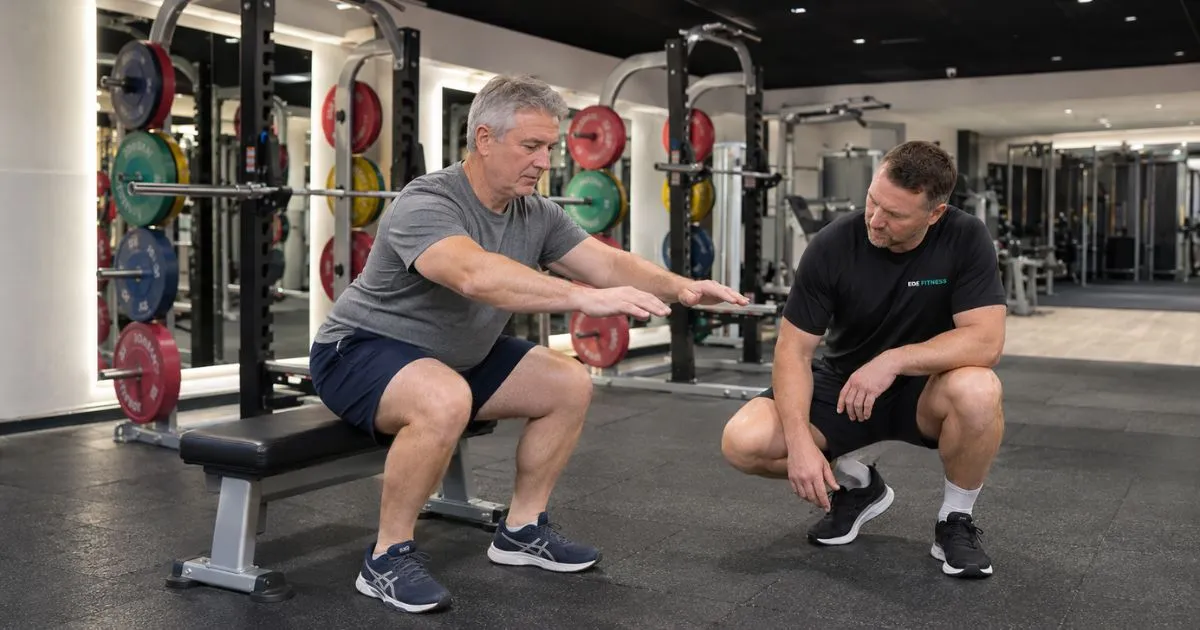
Squats can be scaled down a long way, whether that's squatting to a box or bench, holding on to a rail for support, or simply working through a smaller range.
Leg presses let you control the load and the depth while taking balance out of the equation, which a lot of sore knees seem to appreciate.
Knee extensions get a bit of a bad press, but they're actually one of the most direct ways to load your thigh muscles, and they're used widely in rehab. Some knees just need a shorter range and a lighter weight to tolerate them.
Lunges are often the hardest ask for a sensitive knee, because you're combining balance, depth and single-leg load all at once. A static split squat or a step-up onto a low box is usually an easier place to start.
Which ones suit you really comes down to you as an individual, and that's why I'm wary of any "best workout for bad knees" list. If I'm honest, that sort of thing is marketing rather than coaching.
How to judge whether the session was manageable
While you're training, it helps to learn the difference between muscular effort and joint symptoms. Burning thighs and heavy legs are just the work doing its job, whereas a sharp or catching pain in the joint, or one that keeps building as you go, is information you should act on.
How your knee feels later that day and the following morning tells you a lot more than how it felt halfway through a set. NICE actually advises that joint pain can increase a little when someone first starts therapeutic exercise, and that regular, consistent exercise still benefits the joint, so feeling your knee a bit more than usual isn't automatically a problem.
To make this a little more practical, physiotherapists often use a pain-monitoring model that was originally developed for kneecap pain. You rate your pain from 0 to 10, and roughly speaking, 0 to 2 is considered safe, while anything up to 5 is considered acceptable during or after exercise, as long as it settles down by the next morning and doesn't gradually creep up from one week to the next. Anything above 5 is a sign to ease off. It's a guide that's used in rehab rather than a hard and fast rule, and if your physio has given you different limits, you should go with theirs.
There are really three patterns I'd keep an eye on:
If your symptoms settle by the next morning, you can carry on and build things up gradually.
If they're getting worse session after session, or your knee's swollen the next day, take a step back and let your coach know.
If everyday things start getting harder, like the stairs, walking or sleeping, it's time to get it checked, even if you can still get through a workout.
It's also worth knowing that a bad knee day doesn't have to mean a day off. In two Danish trials of people with knee osteoarthritis, anyone whose pain was above 5 out of 10 before a session did a lighter "rescue" routine instead, and their pain went down afterwards in 63% of those sessions, stayed the same in 27%, and only went up slightly in 10%.
Your knee is only one part of the programme
A sore knee very rarely means the whole programme has to stop. You can usually keep going with upper-body pushing and pulling, trunk work, whatever hip strengthening your knee's happy with and some suitable conditioning, all while the lower-body work is being adapted. That matters more than people tend to think, because keeping the habit going is a big part of the value, and NICE points out that sticking with exercise over the long term is what increases its benefits for osteoarthritis.
It's also easy to forget that the gym sits alongside everything else you're doing. A deliberately light leg session doesn't really add up to a light week if it's surrounded by Sunday football, a 10k and a couple of long dog walks. So when I'm adjusting someone's training around a knee, I'll always ask about their whole week, not just the hour they spend with me.
When a physiotherapist and personal trainer work together
The two roles complement each other really well. A physio assesses the knee, explains what's going on, sets out any rehab you need and tells you what to be careful with. A coach then takes that guidance and builds consistent, progressive training around it over the following months, while also working on your wider strength and fitness.
That's how I work with Physica Health, a physiotherapy clinic in Bagshot. When a knee needs a proper assessment, that's where I'll point someone, and then the training can work with their advice rather than around it.
One last thing I'd say is that being able to finish a workout isn't quite the same as your knee being fine. If a problem keeps hanging around, it deserves some attention, even if you can still train on it.
A practical next step
If you're in or around Lightwater, Bagshot or anywhere else in Surrey Heath and you'd like some help adapting your training around a knee, you can book a free consultation. We'll have a chat about your goals, what you're doing at the moment and any advice you've already had from your GP or physio, so that your plan fits around it properly. And if you'd rather just ask a question first, feel free to email me at [email protected].
Rob Ede is a health-first personal trainer and Level 4 nutrition coach at Lightwater Leisure Centre, Surrey Heath.
Related reading
Is It Too Late to Start Strength Training at 50?
References (for the curious)
NICE. Osteoarthritis in over 16s: diagnosis and management (NG226), 2022. nice.org.uk/guidance/ng226
Lawford BJ, et al. Exercise for osteoarthritis of the knee. Cochrane Database of Systematic Reviews, 2024. doi.org/10.1002/14651858.CD004376.pub4
Bricca A, et al. Impact of exercise on articular cartilage in people at risk of, or with established, knee osteoarthritis: a systematic review of randomised controlled trials. British Journal of Sports Medicine, 2019. doi.org/10.1136/bjsports-2017-098661
Lo GH, et al. Strength training is associated with less knee osteoarthritis: data from the Osteoarthritis Initiative. Arthritis & Rheumatology, 2024. doi.org/10.1002/art.42732
Bartholdy C, et al. A standardized "rescue" exercise program for symptomatic flare-up of knee osteoarthritis: description and safety considerations. Journal of Orthopaedic & Sports Physical Therapy, 2016. doi.org/10.2519/jospt.2016.6908
Thomeé R. A comprehensive treatment approach for patellofemoral pain syndrome in young women. Physical Therapy, 1997. doi.org/10.1093/ptj/77.12.1690
NHS. Knee pain. nhs.uk/conditions/knee-pain
Conaghan P, Anderson A, Pandit HG. Knee pain: here's why it happens and how you can fix it. The Conversation, 2023. theconversation.com