Why Your Back Pain Is a Mechanical Problem, Not an Ageing Problem
Most professionals I work with who have chronic low back pain share one belief: that it's an inevitable feature of getting older. That the disc that showed up on the MRI explains everything. That the best they can do is manage it.
I want to challenge that framing directly, because I think it's wrong, and because accepting it leads to exactly the wrong interventions.
The actual mechanism
The lumbar spine is designed primarily for stability. It is not a highly mobile structure. The joints above it, the thoracic spine, and below it, the hips, are where rotation and range of motion are supposed to happen.
When those adjacent joints lose mobility, the lumbar spine compensates. It takes on movement it isn't built to handle. Do that for long enough and you get predictable consequences: facet irritation, disc loading in the wrong planes, chronic muscular guarding.
Sitting for eight to ten hours a day accelerates this process. Prolonged hip flexion shortens the hip flexors, progressively inhibits glute activation, and pulls the pelvis into anterior tilt. The lower back is now working harder just to keep you upright, let alone absorbing the loads of daily movement.
This isn't ageing. It's a structural adaptation to a movement deficit. The distinction matters enormously, because one has a solution and one doesn't.
Why passive treatment doesn't fix it
Massage, manipulation, and rest address the symptom, the pain signal, not the underlying mechanics. They can be useful for short-term relief, and I'm not dismissing them outright. But used in isolation, they do nothing to rebuild the load capacity of the posterior chain or restore the mobility of the hips and thoracic spine.
There's also a compounding problem with rest: the multifidus, the deep stabilising muscles of the lumbar spine, atrophy quickly with inactivity. So every period of rest that isn't followed by progressive loading leaves you slightly worse off structurally than before the episode.
The evidence for active rehabilitation over passive treatment is now substantial. Movement is the intervention.
The sequencing that works
The approach I use follows a specific order, because loading a system that lacks mobility first is a reliable way to create a new injury.
First, restore mobility in the hips and thoracic spine. I use objective assessments here, specific tests that tell us whether range of motion is actually improving, not just whether you feel looser after a warm-up. This phase offloads the lumbar spine by giving movement back to the joints that were supposed to be providing it.
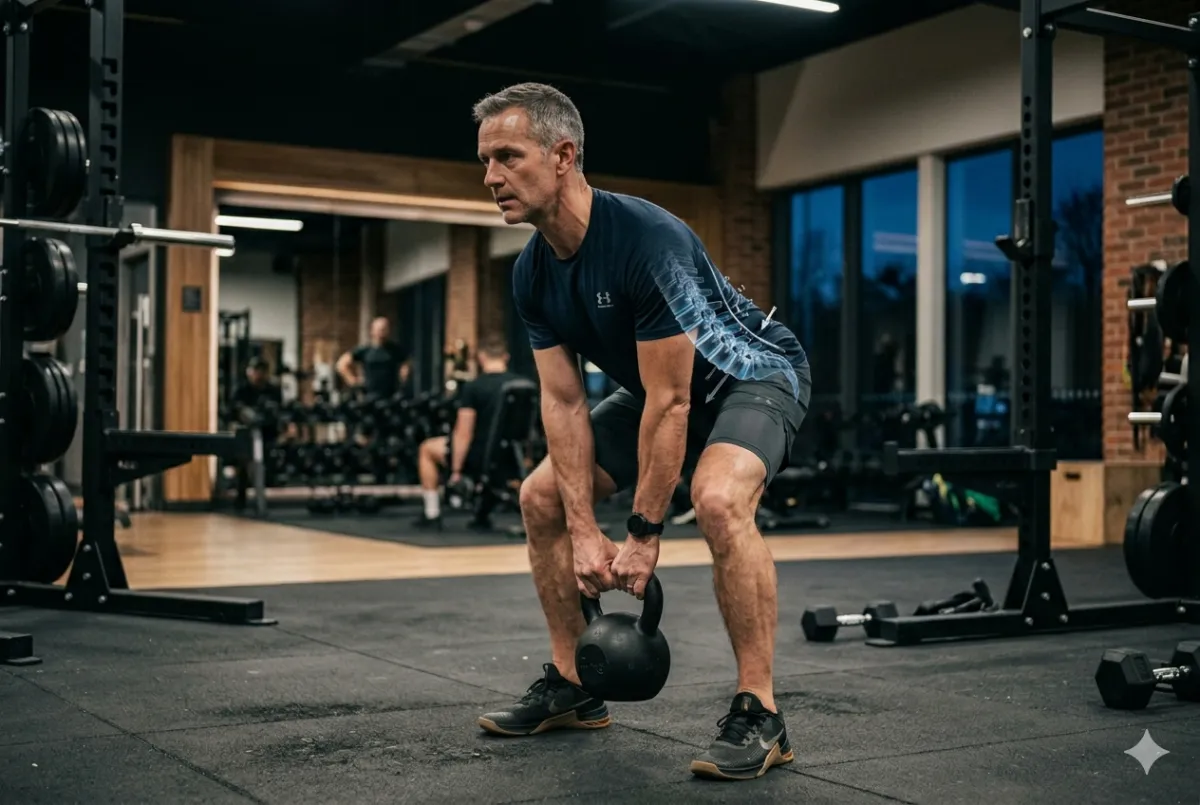
Second, build load capacity. Specifically, the hip hinge pattern, the foundational movement of a deadlift. When this is learned and loaded correctly, it teaches the body to generate force through the glutes and hamstrings rather than the lumbar vertebrae. That pattern then transfers to everything: lifting, sitting, getting in and out of a car, carrying luggage through an airport.
This is not a rehabilitative programme in the physiotherapy sense. It is a strength programme with a clear mechanical rationale.
The risk you're actually carrying
For a professional in their 40s or 50s, chronic back pain is not just a quality-of-life issue. It degrades sleep, which degrades cognitive performance. It limits the physical activity that would otherwise protect your metabolic and cardiovascular health long-term. And it tends to get worse, not better, if the underlying deficit isn't addressed.
The question worth asking is not how to manage the next episode. It's whether the structure that caused it is going to be different in five years.
If you're in the Surrey area and want to work through that question properly, my consultations are at Lightwater Leisure Centre.
Disclaimer: This article is for informational purposes only and does not constitute medical advice. If you are experiencing back pain, consult a qualified healthcare professional before beginning any exercise programme.