At What Age Does Falling Over Become "a Fall"?
At age 7, you fall over. Someone dusts you down, you get a plaster and you're back on your bike before tea. At 25, you fall over and it becomes a story for the pub. Somewhere later in life, the same event goes from "I fell over" to "I had a fall", and people talk about it in serious hushed tones when they mention it. The concerned expression coupled with "Oh you poor dear!"
Nobody can give you the exact birthday when that happens, and I'd argue it isn't really about age at all. It's about what a trip costs you, and how long it takes to get back to normal afterwards. More of that is within our ability to influence than most people think.
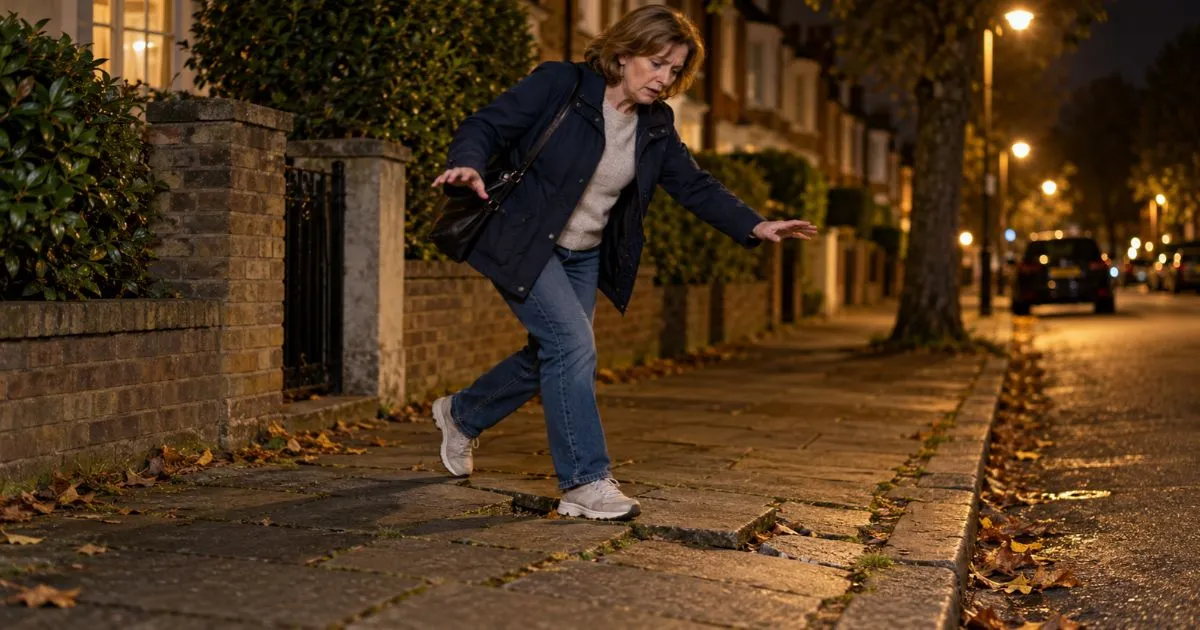
It's been on my mind because my wife recently tripped on an uneven pathway and hurt her face. She walks regularly. It was ordinary bad luck on a bad bit of path, the kind of thing that could happen to any of us, but it got me thinking about the difference between being active and being prepared for the moment your foot catches.
Anyone can trip. What happens next is what counts.
Uneven paving, tree roots, a kerb you didn't see in the dark: these are everyday hazards, not signs of decline. Trips happen at every age. What changes is how the body responds in the half second after the toe catches.
To stay upright, several things have to happen quickly and together. You need to sense that your balance has gone, get a foot out fast enough and far enough to catch yourself, and have enough strength in that leg to take your full weight as it lands. If that doesn't work, your hands, hips and bones take the impact, and how well they cope depends partly on how strong they are.
General fitness doesn't guarantee any of that. It's a specific set of capacities, and they respond to training.
What training can improve
In plain English:
Balance: keeping control of your body over your feet, whether you're standing still or moving.
Coordination: getting the right muscles working in the right order without having to think about it.
Strength: how much force your legs can produce. Enough to get out of a low chair easily, and enough to hold you when you land awkwardly.
Power: strength applied quickly. This is more important than people realise, because a recovery step has to happen fast. Research suggests power declines earlier and faster than strength as we age.
Reactive stepping: the quick, unplanned step you take when you trip or get knocked. It's a skill as much as a physical quality, and it can be practised.
I'm not going to promise you faster reflexes. What the evidence supports is getting better at responding to a stumble or trip. Trials of perturbation-based training, where people practise recovering from controlled, unexpected losses of balance, have reduced falls in older adults.
The wider evidence is solid. A 2019 Cochrane review of 108 trials found that exercise reduced the rate of falls in older people living in the community by 23%. Balance and functional exercise had the clearest evidence, and programmes combining balance work with resistance training probably did better still. Resistance training on its own had much less certain evidence for falls.
There is one caveat: those trials were in people aged 60 and over, and the average participant was in their mid-seventies. If you're 52, you're not the population most of this was tested on. But the capacities being trained are the same, and it's far easier to build them from a decent starting point than to rebuild them later. I've fallen over plenty of times doing Spartan Races in my 40s and 50s, and I just get up and carry on. But, those falls start to feel harder as I get older.
Why bone strength belongs in the discussion
Falls and fractures are linked, but they're not the same thing. Bone responds to load. Progressive resistance training, where the weight gradually increases over time, and appropriate impact, such as brisk stepping, heel drops, skipping or jogging for those suited to it, give bone a reason to maintain or strengthen itself.
This is important because for women around and after menopause, when falling oestrogen speeds up bone loss. The LIFTMOR trial took 101 postmenopausal women with low bone mass, average age 65, and put about half of them through twice-weekly, 30-minute supervised sessions of heavy lifting and impact work for eight months. Their spine and hip bone density improved compared with a lower-intensity group, with only one minor adverse event. The important detail is that it was closely supervised and built up gradually. That's the version that worked, not someone loading a heavy bar on their own after reading a headline.
It's worth being straight about what stronger bones do and don't do. They may make a fracture less likely if you land badly. They do nothing to prevent a graze, a bruise, a cut or a knock to the head. However, the evidence that exercise reduces fractures specifically is weaker than the evidence that it reduces falls. Fewer injurious falls across a group doesn't mean any individual fall will be a gentler one.
Where walking fits
Walking is brilliant. It's good for your heart, blood pressure, blood sugar, mood and joints, and it's the activity people actually stick with. I'd never talk anyone out of it.
But walking on its own hasn't shown a clear effect on falls. In one Australian trial, a 48-week walking programme got previously inactive older people walking more, but didn't reduce falls or improve balance. That's not a criticism of walking. It just doesn't challenge your balance near its limits, build much leg strength, train fast reactive steps, or load bone as heavily as bone responds to best. Walking is the foundation; strength and balance work is a separate tool for a separate job. You want both.
What this looks like in practice
You don't need anything complicated. A few accessible starting points:
Sit-to-stands or squats. Stand up from a chair and sit back down with control. Progress by lowering the seat, holding weights, or standing up briskly and lowering slowly, which starts to train power as well as strength.
Step-ups. Onto the bottom stair or a sturdy step. Progress through height, then added weight, then stepping on and off in different directions.
Calf raises. Up onto your toes and slowly back down, holding a worktop at first. Progress to one leg at a time. Strong calves matter for that recovery step.
Supported balance. Stand with one foot directly in front of the other, or on one leg, with a hand hovering near a worktop. Progress by reducing support, then adding head turns or reaching.
The principle that matters is progression. Make it slightly harder as it gets easy, rather than repeating the same comfortable session for years. UK guidelines recommend strength activities on at least two days a week, and for older adults, strength and balance work on at least two days. In the falls research, the bigger effects came from programmes adding up to around three hours a week or more that included balance and functional exercise.
A fit 55-year-old and someone a few months out from a hip operation need very different versions of the same idea. The common mistakes I see are starting too gently to get any benefit, or copying something online that doesn't suit where you are.
When exercise advice needs individual assessment
Speak to your GP first if you have persistent balance problems, repeated or unexplained falls, dizziness, or known osteoporosis or previous fractures. Unexplained falls can have medical causes, such as blood pressure, medication, vision or inner-ear problems. People with osteoporosis can and should exercise, but the type and intensity may need adapting, particularly after a spinal fracture.
For ongoing balance problems or dizziness, a physiotherapist is often the right next step. Locally, Physica Health in Bagshot offers vestibular (balance) rehabilitation, and it's where I'd point someone whose balance needs assessing before training.
Building it in now
Nobody can promise that training will prevent a particular accident. Uneven ground doesn't check how fit you are before it catches your toe. What training can do is shift the odds in your favour: better at catching yourself, stronger when you land, steadier on your feet in general.
The best time to build that capacity is before you need it, alongside the walking you already do. If you'd like help putting together strength and balance training that fits your current ability and goals, you can book a chat here or email me at [email protected].
Rob Ede is a health-first personal trainer and Level 4 nutrition coach at Lightwater Leisure Centre, working with adults over 40 across Surrey Heath.
Related reading
Is It Too Late to Start Strength Training at 50? Why it isn't, and how strength work protects the everyday capability and independence this article is about.
Menopause, Muscle and Metabolism. A closer look at what happens to muscle and bone around menopause, and why strength training is critical at this stage of life.
Weight Loss After 40. Why fitness is about more than the number on the scales, including where walking fits and how to protect bone while losing weight.
References (for the curious)
Sherrington C et al. (2019). Exercise for preventing falls in older people living in the community. Cochrane Database of Systematic Reviews. cochrane.org/CD012424
Sherrington C et al. (2020). Evidence on physical activity and falls prevention for people aged 65+ years: systematic review to inform the WHO guidelines. International Journal of Behavioral Nutrition and Physical Activity. doi.org/10.1186/s12966-020-01041-3
Mansfield A et al. (2015). Does perturbation-based balance training prevent falls? Systematic review and meta-analysis. Physical Therapy. PubMed
Reid KF, Fielding RA (2012). Skeletal muscle power: a critical determinant of physical functioning in older adults. Exercise and Sport Sciences Reviews. PMC
Watson SL et al. (2018). High-intensity resistance and impact training improves bone mineral density and physical function in postmenopausal women with osteopenia and osteoporosis: the LIFTMOR randomised controlled trial. Journal of Bone and Mineral Research. PubMed
Brooke-Wavell K et al. (2022). Strong, steady and straight: UK consensus statement on physical activity and exercise for osteoporosis. British Journal of Sports Medicine. bjsm.bmj.com
Voukelatos A et al. (2015). The impact of a home-based walking programme on falls in older people: the Easy Steps randomised controlled trial. Age and Ageing. Western Sydney University
UK Chief Medical Officers (2019). Physical activity for adults and older adults. GOV.UK