What Does a Nutrition Coach Actually Do, and Are You Making the Most of Yours?
You know the basics already. Eat your veg. Protein matters. Run a surplus for long enough and the fat loss stops. If you're in your forties or fifties and reasonably switched on, you've read all of it, probably more than once.
Hasn't fixed much, though, has it.
Because none of it helps at half nine at night when you're stood at the fridge, knackered, after the 19:42 out of Waterloo. It doesn't touch the dinner your family actually wants to eat, or the lunch a client ordered for the whole table, or the Saturday that quietly wipes out a decent week. The theory isn't what trips people up — it's trying to execute it on a wet Tuesday when everything else has gone wrong.
That gap is my job. It's also the part of my service most clients barely touch — a shame, because it's often the bit doing the heavy lifting. So: what nutrition coaching actually is, how it differs from the regulated professions, where I stop, and how to get more out of it if it's already in what you're paying for.
The reading was never going to be enough
Here's the uncomfortable bit. When researchers go looking for a link between knowing more about food and actually eating better, they find one — but it's weak. A bit more knowledge buys you a slightly better diet, and little more.
Nobody in this age group is short of information. What they're short of is a way to apply it when the week is against them — which is why "eat less, move more" fails busy professionals.
That's the whole reason I have a job. If facts fixed people, my inbox would be empty.
What the work actually looks like
It's a loop, mostly. Less glamorous than the internet makes out.
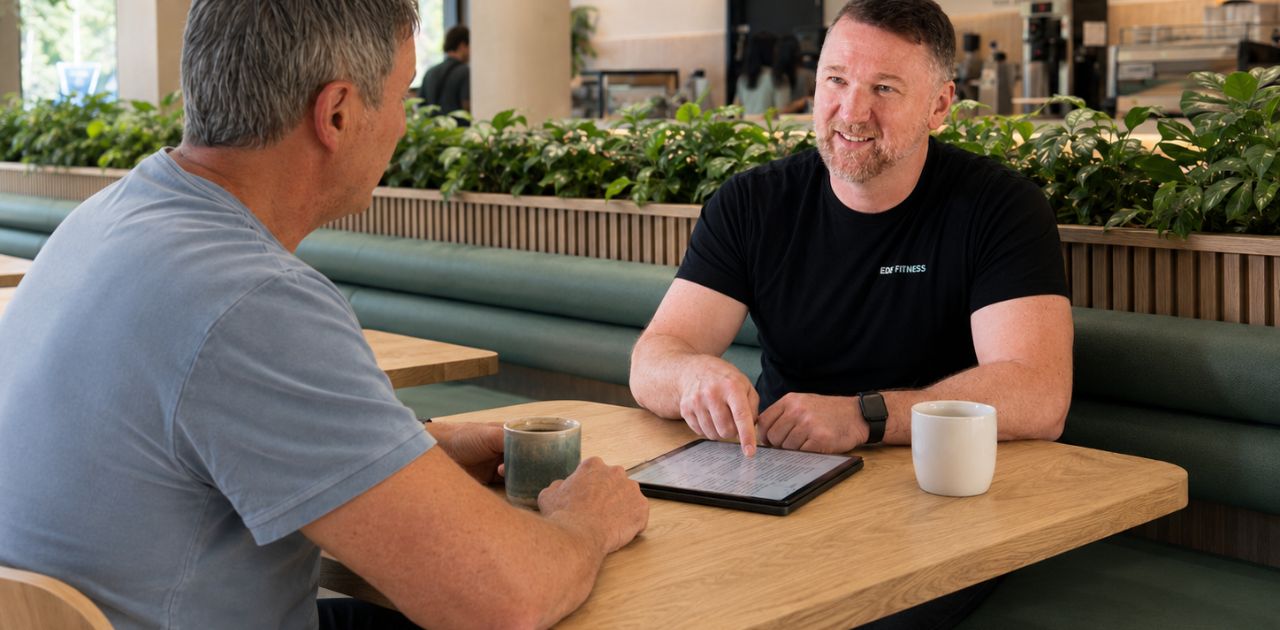
I get an honest picture of how you eat now — a food diary, a few questions about what a real week looks like — and I pull out the two or three things that matter and ignore the noise. We agree a couple of changes that stand a chance of surviving your actual life, not some idealised version of it. Then you go and live it, we look at what really happened, and we adjust. Again the week after. And the week after that.
The value isn't one clever tip you could've found on YouTube. It's that loop running for months, with someone paying attention who's seen this a few hundred times and knows which lever to pull next.
What it isn't: judgement. It's not a punishment for a rough weekend, and it's not a generic meal plan I've printed off for forty people with your name typed at the top. I'm not diagnosing anything. And I'm certainly not there to check whether you've "been good." That word does real damage. I don't use it.
Coach, nutritionist, dietitian — and the one word that's protected by law
Quick detour, because people get burned here and I'd rather you didn't.
"Dietitian" is the only nutrition title protected by UK law. Nobody can call themselves one unless they're registered with the Health and Care Professions Council, which sets legal standards for their training and conduct. Dietitians assess, diagnose and treat — diabetes, allergies, gut and kidney disease, cancer care. That's clinical healthcare, and it's a genuinely different job from mine. If you need one, you need one, and I'll tell you so.
"Nutritionist" isn't protected by law. There's a good voluntary register run by the Association for Nutrition, and being on it means something — but it's a voluntary standard, not the legal one behind "dietitian." And "clinical nutritionist" catches a lot of people out. It sounds official. It isn't a protected title, and on its own it tells you nothing about whether the person is heavily qualified, half-qualified, or trained over a weekend. So if a title matters to you, don't take it on trust. Look them up — the HCPC register is free and takes a minute.
I'm a nutrition coach. Real job, real scope. Part of doing it properly is being straight about where the edges are.
What's in scope for me, and when I send you to your GP
There's plenty I can help with, and I'm good at it. Everyday food choices. A meal structure that survives a busy week. Getting your protein up. Eating sensibly around your training. And the big one — turning "I know what I should do" into something you're still doing in three months.
Some things sit firmly outside my lane, and I'll name them rather than blur them. I don't diagnose. I don't read your blood tests. I don't treat eating disorders or write medical diets for diagnosed conditions — that's your GP or a dietitian, and I'll say so on the spot. If your weight's dropping for no reason, or climbing alongside things like pre-diabetes, high blood pressure or sleep apnoea, or there's any sign of a difficult relationship with food, you'll get pointed to the right person, quickly.
A coach willing to say "this one isn't mine to manage" is a safer bet than one who thinks they can handle everything. That honesty is part of what you're buying, not a hole in it.
So what are you actually paying for?
Not the information. That's free and everywhere, and it clearly hasn't been enough on its own.
You're paying for advice built around your shifts, your budget, your appetite, your family and your training — not a handout. For someone whose job is to spot the one obstacle that keeps tripping you and get you past it. For the join between what you eat and how you train, recover and change shape. And for a plan that keeps getting adjusted as life moves.
Or, the way I'd put it to your face: nutrition information is widely available. The value of coaching lies in determining which changes matter for you, making them realistic and helping you follow through consistently.
The bit clients leave on the table
This next part is really for the people already training with me. Read it as a nudge.
Nutrition coaching is in your package. It's not an upsell and it's not an extra — you're already paying for it. But it's completely natural to walk in focused on the session in front of you: the lifts, the hour, done. The eating side gets a passing mention on the way out, if it gets one at all.
That's fine, right up until it isn't. The moment your eating is what's capping your energy, recovery or results, touching on it once a fortnight means you're using a sliver of what you've bought. None of it — the assessment, the accountability, the feedback, the adjusting — works on autopilot. It needs you in the room and honest.
Getting more out of it isn't complicated. Do your check-ins properly. Send me a food record that looks like a normal week, not a three-day showreel of your best behaviour. Tell me about the cravings, the 11pm grazing, the wedding, the work trip where it all fell apart. Ask me things. And when a plan clearly doesn't fit your life, say so — instead of nodding along and quietly binning it the week after.
My side of the deal: I am not the food police. I cannot usefully adjust a strategy if I am working from an edited version of what is happening. Give me the messy version. It's the only one I can actually do something with.
The people this tends to click for
A few types come through the door again and again. You might spot yourself.
The one who could recite the advice back to me word for word and still can't run it two weeks straight. The Monday-to-Friday saint whose weekend resets the lot. The person training hard, eating "alright," quietly baffled their body isn't changing — nearly always because the protein and structure aren't where they think. Get enough protein while you're training and you hold muscle and actually change shape; that's about as settled as nutrition science gets. The one who can't get near enough protein in the first place. And the one who's done every diet going and lasted on none of them, because a plan you can't stand was never going to survive a real week.
If more than one of those stung — that's not a willpower defect. It's an execution problem. And execution problems are the ones I'm actually good at solving.
What that looks like when it works
Mandeep came to me with the exact worry I hear most: that she'd struggle with the training, feel embarrassed, and not manage to stick to it. She started anyway. Ninety days later, here's how she put it:
"This programme has taught me the art of adopting a lifestyle of healthy eating and exercising. I've been able to achieve my goals without cutting any desirable foods out of my diet, and still treat myself. It's changed my relationship with food, my mindset and my well-being for the better, and I have so much more energy. Rob has a wealth of knowledge and has always answered my questions in a way I could understand, with my well-being at the front of his mind throughout." — Mandeep, PrimeFit coaching client

Notice what she didn't mention? No banned foods, no miserable restrictions, and no living on lettuce. That's the point — the changes have to fit the life, or they don't last. Her results came from applying the basics consistently, not from white-knuckling a diet she hated.
What it can't do
I'd rather undersell this than have you feel sold to.
Coaching isn't magic. The honest research picture is that it helps — modestly, reliably, for most people who properly engage with it — not that it works miracles. The result still comes down to your choices. I can build the plan and hold you to it. I can't eat your meals for you. No dramatic before-and-after promised, no medical treatment, and I won't pretend every problem is behavioural when plenty aren't.
Even food tracking, which I lean on a lot, isn't for everyone — for anyone with a difficult relationship with food it can be the wrong tool entirely, and there I'd drop it without hesitation. The right approach depends on the person in front of me. Which is rather the whole point of having one.
If that hit a nerve
Most people over 40 don't need another nutrition fact — they need help turning what they half-know into something that survives a real, busy week, and someone to change the plan when it doesn't. That's the job. It's also the easiest thing in the world to leave untouched.
That's exactly what I do. I coach nutrition and personal training together for adults over 40 at Lightwater Leisure Centre, and the two pull far harder in harness than either does alone — you can see how I work at edefitness.com. Whether you're commuting out of Bagshot or running something in Windlesham, the aim's the same: a plan you can actually keep.
So if your eating's holding back your strength, your fitness, your shape or your long game, come and talk it through — no obligation, no lecture, and no charge for the first conversation. Book a free consultation and we'll work out what's genuinely getting in your way. Or just email me: [email protected].
Related reading
How Much Exercise Do You Actually Need After 50? — the training side of the same coin: why under two-and-a-half hours a week is enough, if it's the right kind.
Why I Became a Personal Trainer — the honest story behind the evidence-led way I coach.
References (for the curious)
Spronk I, et al. (2014). Relationship between nutrition knowledge and dietary intake — the weak link between knowing and doing. https://pubmed.ncbi.nlm.nih.gov/24621991/
British Dietetic Association. What are the differences between dietitians and nutritionists? — on the protected title. https://www.bda.uk.com/about-dietetics/what-is-dietitian/dietitian-or-nutritionist.html
Nunes EA, et al. (2022). Protein intake to support muscle mass and function in healthy adults — protein plus resistance training and lean mass. https://pubmed.ncbi.nlm.nih.gov/35187864/