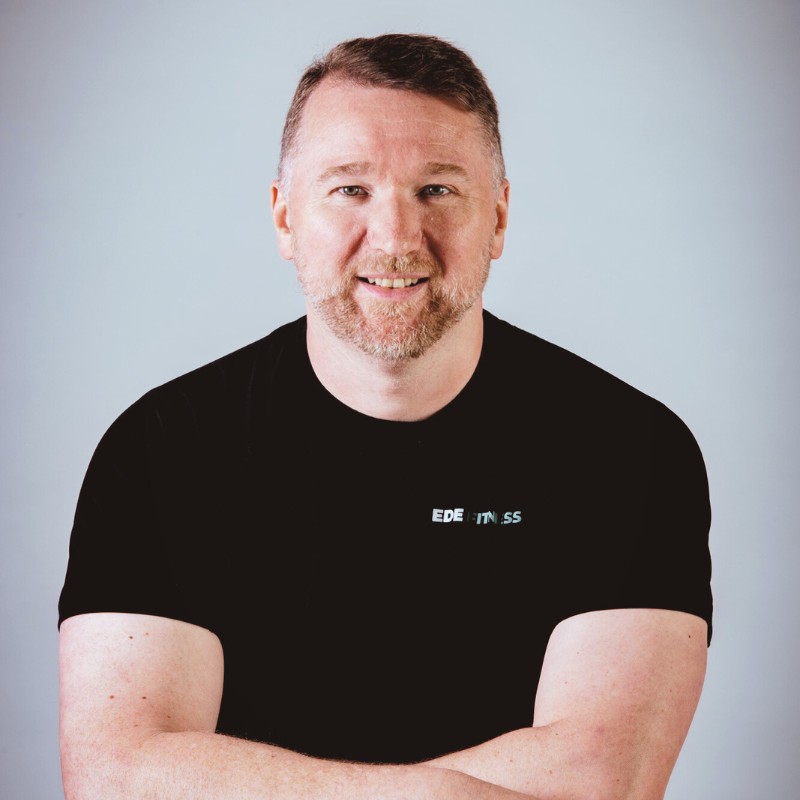
My Health Journey: Why I Became a Personal Trainer
I've been mocked for being too skinny and mocked for being overweight. I've believed bodybuilding magazines. I've followed more crash diets than I care to admit. I've drunk to cope with anxiety. I've failed obstacle races. None of those experiences made me a coach. They taught me how easily good people end up believing the wrong things about health.
That's the whole reason I do this now. So if you want to know whether I'm the right person to help you, this is the honest version, not the polished one.
The skinny kid who wasn't "the sporty type"
I was a very skinny child and I got bullied for it. The names were about what you'd expect. "Chicken Legs." "Weedy Ede." I don't say that looking for sympathy, because it was fairly ordinary playground stuff, but it has a way of getting in. After a while you stop arguing with the picture other people have drawn of you and just accept it. If you were ever the kid picked last, or the one who decided early that sport wasn't for people like you, you'll know what I mean.
What took me years to work out is that I was actually a fairly active kid. I skateboarded and roller skated, I did athletics, and from my teens I played badminton at the local club, which is a sport I still play now. None of it counted for much, because it wasn't the kind of sport the people doing the judging cared about.
At one parents' evening, a PE teacher said to my mum, "Robert's not very athletic, is he?" She wasn't having it. "What do you mean? He skateboards, roller skates and plays badminton." His answer was, "Well, he's not like his brother." My older brother played rugby for the school. And my mum just said, "And who says he has to be?" That sentence has stuck with me for forty years.
Labels work like that. They get attached to you whether they fit or not, and if you carry one long enough it stops being a thing someone said and turns into something you believe about yourself. I wore "not the sporty type" for decades and let it set the limits of what I'd even attempt. Most of the people I coach now arrive wearing one of their own, whether it's "not disciplined" or "not confident" or "not a gym person", and none of it is true in the way they think it is. The most useful thing a coach can do is the thing my mum did without thinking that evening, which is refuse to measure you against someone you were never supposed to be. The job is to help you become a better version of yourself, not a worse copy of somebody else.
Believing the magazines
When I did finally want to change my body, I went looking in completely the wrong place. I took Muscle & Fitness at face value. I assumed those physiques were the pure product of training, discipline and the right diet, and that if I just worked hard enough I'd end up looking like that. What nobody mentioned, least of all the magazines, was how many of those bodies were built on anabolic steroids. I was holding myself to a standard that didn't physically exist.
Chasing a fantasy like that does real harm. You pour effort into the wrong things and feel like a failure for not reaching somewhere you were never going to reach. It's also where I first ran into a lesson I repeat constantly now, which is that marketing and evidence are two completely different things, and a lot of people get hurt because they can't tell which one they're looking at.
Mocked at the other end
Then life did something almost funny. The skinny kid grew up and got fat, and the same sort of people who'd had a go at me for being thin now had a go at me for being heavy instead. The nickname that era handed me was "Jabba the Gut".
So I've been judged at both ends of the scale, and it taught me something I still come back to. People will find something to say about your body no matter what it looks like, so if you're getting fit to win their approval, you're chasing a finish line that keeps moving. It's the wrong reason to start and it never lets you arrive.
The dieting years
So I did what most people do, which is go looking for the fix, and I tried plenty of them. FatmanSlim, living on something like 1,500 calories a day, 5:2, keto, vegan, intermittent fasting, years of calorie counting. Each one turned up promising to be the answer.
The thing most people get wrong, me very much included back then, is assuming the diets failed because they were rubbish. They weren't. Most of them worked, for a few weeks at least. The problem was never the diet. The problem was that I thought the diet was the answer. I'd lose the weight, then put it all back on, again and again, because I was treating the fat itself as the thing to fix. But the fat was never the problem. It was the result. What actually needed sorting was the pile of everyday habits underneath it, and no eight-week plan on earth was going to touch that. That single realisation sits under almost everything I do as a nutrition coach now.
There's a second cost nobody in the diet business talks about, which is what all that failing does to your head. Every attempt that collapses takes a little more of your belief that you can change at all, and rebuilding that belief is usually the first real job, long before we go anywhere near what's on your plate.
The part underneath all of it
Underneath all of this, for years, were two other things: anxiety and depression, and a glass of wine in my hand most evenings. The drinking is easy to misread, so let me be accurate about it. I wasn't dependent and I wasn't physically addicted to anything. What I eventually noticed was more interesting than that. I wasn't drinking because I enjoyed the wine. I was drinking for the few hours it changed how I felt. The alcohol was patching over a different problem, and using it that way only let the real one grow. My last ever drink was a pretty grim French red on Christmas Day 2009. I woke up on Boxing Day, thought "that's it, I'm done", and I've not touched a drop since.
The anxiety and depression were a harder thing to shift, and they hung around for years. I kept running and training all the way through the worst of it, and I'll tell you something the industry tends not to: the exercise helped, but it did not cure anything. Anyone selling you a gym membership as a fix for depression is overselling it. Training looked after my body. It never reached the thinking going on underneath.
What did reach it, in 2018, was a programme called Thrive that I worked through with a Thrive coach. I'll always tell that as my own story rather than a promise it does the same for everyone. But the change wasn't really in my mood. It was in my understanding. I could suddenly see how many limiting beliefs I'd been feeding for years, and I came out the other side genuinely convinced I had far more say over my own thinking than I'd ever realised. That went well past my mental health. It taught me the idea I now build all my coaching on, which is that information by itself doesn't change anyone. Identity and belief are what move the needle. You can hand a person a flawless plan, but as long as they still believe they're "not the type", that plan is dead on arrival. I'd know. I was that person for twenty years.
All of which is to say I know from the inside what it's like to try the obvious things, watch them fail, and keep looking until something finally works. That's what a lot of my clients are really carrying through the door, even when the only thing they mention is the weight.
Obstacle racing, and a coach called Joe
Then something shifted, although it didn't look like progress at the time. My first proper test was a Tough Mudder, and I hated every minute of it. I was carrying too much weight and nowhere near strong enough. I could run the distance fine, but I couldn't crawl through the things you had to crawl through or pull myself over the things you had to climb, so I ended up going round half of them. There were electric shocks near the end that I could happily have lived without. I got over the line feeling less like I'd done something and more like I'd been rumbled. And the reason it felt like a failure had nothing to do with finishing, because I did finish. It was that I'd spent the whole day measuring myself against everybody else on the course. The same old trap, just muddier this time.
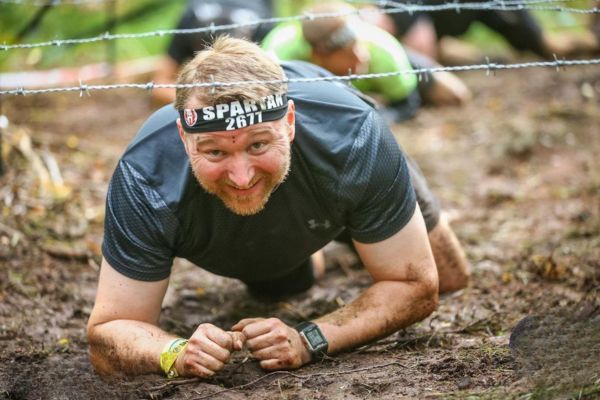
What changed things was going back and doing it again, and then again. I moved on to Spartan races, and somewhere in among them the whole story turned over. I still failed plenty of obstacles. But every race left me a little stronger and a little more capable than whoever had turned up to the last one, and for the first time in my life I stopped caring how I looked and started caring about what I could actually do. Spartan's line is "you'll know at the finish line". I'd taken that to mean simply getting to the end. It turned out to mean something much larger, that health was never about the mirror, it was about being more capable this year than you were the last. The same finish line that had shown me up at Tough Mudder became, a handful of races later, the place I finally put that old label to bed.
Around the same time I started training with a brilliant personal trainer called Joe, and he was the first person to show me what coaching is actually meant to look like. He didn't shout, he didn't try to punish me into shape, and he had no interest in moulding me into a copy of anyone else. What he did was listen. He worked out what genuinely mattered to me, the badminton and the obstacle racing, and he trained me towards those, not towards some cover model and not towards his idea of what I should be. He simply helped me get better at the things I cared about. That is more or less the whole of how I coach today, and it's the precise opposite of a PE teacher writing a child off. One of them decided what I couldn't become. Joe helped me find out what I could. I didn't realise it then, but I was taking notes on the sort of coach I'd eventually try to be.
Successful on paper, and still not sorted
What usually surprises people is that all of this was happening while my career was, on paper, going rather well. I spent the best part of a decade at Microsoft, ending up as a Senior Technical Account Manager, dealing with data and senior people all day. A stable job, a family, a predictable path ahead, the sort of life that looks completely sorted from the outside.
It's worth saying plainly, because people assume otherwise: the career success and the private mess ran alongside each other for years. Being good at your job does nothing for your health, your head or your relationship with your own body. I'm the proof of it. I reached my late forties with the career more or less sorted and almost none of the rest of it figured out.
So I hired a career coach, the original idea being to climb a bit higher. The conversations wandered a long way past work though, into what actually gave me energy and what flattened it. One afternoon she stopped me halfway through a sentence, having spotted something I hadn't. Every time the subject moved to training or nutrition or racing, I came alive. I got animated. I'd be smiling without having noticed I'd started.
"You light up whenever you talk about fitness," she said. Then she asked: if there were no obstacles, no money worries and no practical limits, what would I choose to do?
I didn't have to think about it. "I'd become a coach."
The thing that mattered about that conversation wasn't that it eventually led me out of Microsoft. Leaving was just admin, and it came later anyway. What mattered was that, for the first time, I knew what I was actually for.
Why coaching, and not the gym-bro version of it
What surprised me was that none of it was about vanity. I had no interest in training elite athletes or building bodybuilders or producing before-and-after photos. I wanted to be the coach I could have done with twenty years earlier. And the people who come to me now tend to be carrying the exact things I lugged around for years: the same labels, the same wrong ideas about what health is supposed to look like, the same weariness of trying hard and getting nowhere.
I'd made the mistakes myself, all of them. I'd swallowed the magazines whole, starved myself on crash diets, chased symptoms instead of causes and spent years mixing up "looking fitter" with "being healthier". If I could help one person dodge even a slice of that, it felt like a thing worth doing with my time. That idea is the entire reason the business exists.
Becoming an evidence-based coach
I qualified the slow way, studying on evenings and weekends around the day job, first as a personal trainer, then in nutrition, then strength and conditioning. The further in I got, the less I trusted easy answers. There is no magic exercise and no perfect diet and no single supplement that does the work. There's understanding people, and there's doing the ordinary things properly, and that's about it.
This is where the decade at Microsoft earned its keep. I'd come from a world where you don't win an argument by sounding confident, you win it with evidence, and where changing your mind in the face of better evidence is the whole point rather than an embarrassment. Fitness, I discovered fairly fast, runs the other way round, long on confidence and short on proof. So I went to the source and started reading the research itself, the meta-analyses, the clinical guidelines, the systematic reviews. Some of it backed up what I'd been taught and some of it blew it apart, and I found that far more exciting than threatening.
These days anything I recommend has to get past three questions before it reaches a client. Is there good evidence for it? Does it make sense for a real person with a real diary and a real life? And would I be happy recommending it to someone I actually care about? If I can't answer yes to all three, it doesn't get taught.
What I'm actually trying to do now
I'm a grandad now, and that shapes how I see all of this more than any certificate on the wall does. I've no interest in being lean for a photograph. What I care about is staying strong and mobile and independent for as long as I possibly can, and helping people around my age do the same.
What I enjoy is honestly quite small-scale, and it satisfies me more than I can easily explain: getting to the gym early, watching someone manage a thing they were sure they couldn't, helping a person get strong enough to keep up with their grandchildren, rebuilding the confidence of someone who spent years deciding they weren't "the sporty type". That last one I know from the inside. I was that kid.
Looking back, I don't really think I changed careers at all. I think I finally found the thing I was supposed to be doing. The bullying, the wreck of diets, the anxiety, the obstacles I couldn't get over, none of it turned out to be wasted. Every last bit of it became something I can use to help the next person stay out of the same hole.
What I'm trying to do is straightforward enough: help ordinary adults get healthier and stronger and more capable, and stay that way for the long run. I don't coach from theory. I coach from evidence and experience and a fair bit of hard-won empathy, because I've made most of these mistakes with my own two hands and I know exactly what it takes to climb back out of them. That's who I am, and PrimeFit exists for a single reason. I wanted to become the coach I wish I'd met twenty years earlier. If you walk away from working with me more capable than the day you started, then that's the job done, and that's my finish line.
If any of this sounds familiar, and you're in or around Surrey Heath, the next step is just a conversation. No commitment, no sales pitch, just a chance to talk through where you are and what a sensible plan would actually look like. You can book a consultation at edefitness.com or email me directly at [email protected].
You might also find these useful
Is a Personal Trainer Worth It After 50? Here's What You're Really Paying For
Why the real value of coaching isn't motivation, it's having the right plan when your body starts changing.
Why Busy Professionals Neglect Their Health After 40
Discover why career success often comes at the expense of your health, and how small changes can help you regain control.
The Structural Cost of a Corporate Career
How years behind a desk quietly reshape your body and what you can do to reverse the damage.