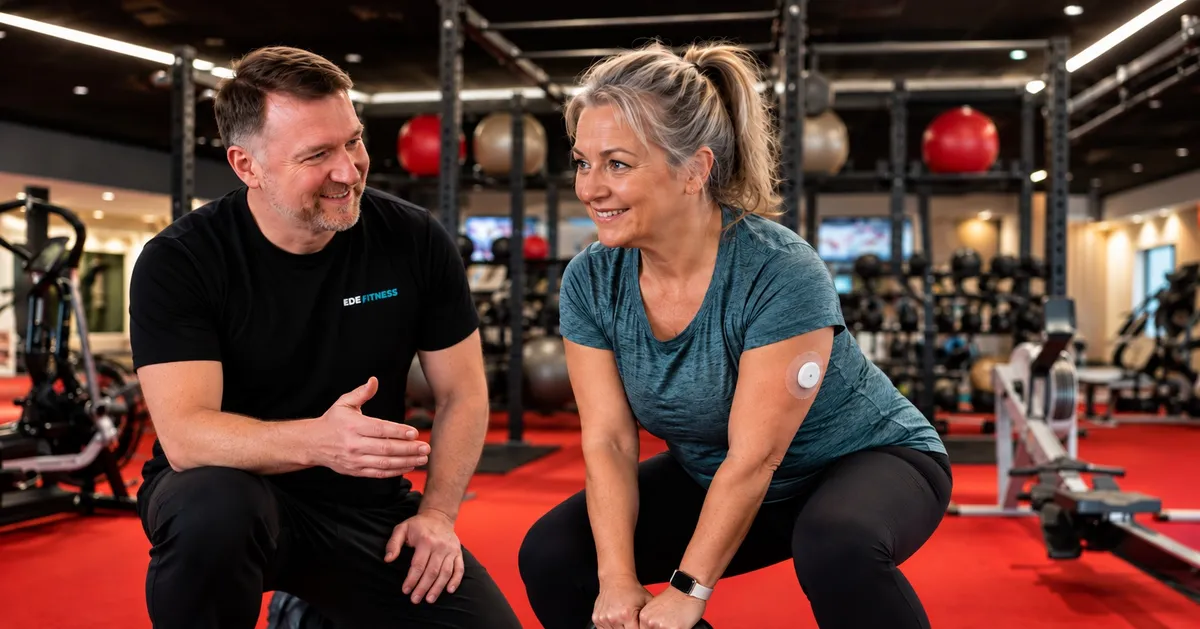
Personal Training With Type 2 Diabetes: How to Choose the Right Trainer in Surrey Heath
If you've got type 2 diabetes, the right personal trainer is the one who asks about your health, your medication and any complications before asking you to lift anything. They should be able to explain, in plain English, why strength training helps your blood sugar. And they should be clear about where their job stops and your diabetes team's starts.
Their 6 pack abs or how they look tells you nothing about any of that. Neither does a big social media following.
Here's what to look for, the questions worth asking, and the red flags that should send you elsewhere.
Why it's worth being choosy
Exercise is one of the most useful things you can do with type 2 diabetes. Strength training in particular lowers HbA1c, and the latest joint consensus from the American Diabetes Association and the European Association for the Study of Diabetes, published this month, now treats regular strength work as a fundamental part of care.
It's also a common condition locally. Surrey's 2025 Pharmaceutical Needs Assessment recorded 6,047 people registered with diabetes in Surrey Heath in 2022/23, 6.7% of patients aged 17 and over. So there's no shortage of people in Lightwater, Camberley, Bagshot, Frimley and Windlesham asking this question.
But diabetes changes the details. Medication, blood sugar swings and complications all affect what's sensible in a session. Most people don't need a radically different programme. They need a coach who knows what to check and when to say "speak to your doctor first".
1. Ask what they know about type 2 diabetes specifically
A Level 3 personal training qualification is the sensible baseline in the UK. On its own, it doesn't tell you much about diabetes.
So ask directly: "What training do you have that covers type 2 diabetes?" A good coach will give you a straight answer without getting defensive. Mine is a Level 4 nutrition coaching qualification that covers type 1 and type 2 diabetes, alongside Level 3 personal training and Level 4 strength and conditioning.
Then ask what they've actually done with it. Have they coached people with diabetes before? How do they handle medication and hypos in a session? Experience shows up in the specifics.
And check they're properly insured. It's a dull question, and it matters.
2. The first session should be a conversation, not a workout
If someone wants to put you through a workout before they know your medical history, walk away.
A proper start includes a health questionnaire and a conversation about:
your diagnosis and how long you've had it;
your medication, especially insulin or tablets such as gliclazide;
any hypos you've had, and how you recognise them;
complications, including heart problems, reduced feeling in your feet, eye disease and kidney disease;
what your GP or diabetes nurse has told you about exercise.
This isn't box-ticking. Each answer changes the plan. Reduced sensation in your feet means checking footwear and being careful with high-impact work. Some eye conditions mean avoiding very heavy straining or breath-holding until you've been cleared. A history of heart problems may mean getting medical sign-off before anything strenuous.
Someone with well-managed diabetes and no complications can usually train much like anyone else their age, with a few sensible checks. Someone with recurrent hypos or advanced complications needs a more careful start. A competent coach can tell the difference, and knows when to send you back to your doctor before going any further.
3. Ask them: "How does strength training help with type 2 diabetes?"
This is the best single question you can ask, and you don't need a physiology degree to judge the answer.
A good answer covers something like this. Muscle is where most of the sugar from a meal ends up. When muscle contracts, it pulls glucose in through a route that doesn't depend entirely on insulin, which is why exercise helps even when insulin isn't working well. Regular training improves how your muscle responds to insulin over time. And the research suggests that the more strength people gain, the bigger the drop in HbA1c tends to be.
So the training has to make you stronger. Waving a light dumbbell about isn't the same stimulus.
Be wary of anyone whose whole answer is "burn calories" or "lose as much weight as possible". Losing excess fat can be very beneficial, and for some people it leads to remission. But losing muscle along the way removes the very tissue that does so much of the work of clearing glucose. A good plan protects strength while you lose fat.
4. They should understand hypos, and leave your medication alone
Exercise affects blood sugar, and not always in the direction you'd expect. Walking and steady activity usually bring it down. Short, intense efforts can push it up temporarily.
If you take insulin or a sulphonylurea such as gliclazide, the main risk is a hypo, either during the session or hours afterwards. Your coach should know the warning signs, such as shaking, sweating, confusion or sudden hunger, and know what to do. In practice, that means you bring your hypo treatment, you check your levels if you've been advised to, and the session stops if something's not right.
What a coach must never do is adjust, reduce or tell you to stop your medication. That's your diabetes team's job, full stop. A good coach works alongside your medical care, and is happy to share what you're doing in training so your GP or nurse can factor it in.
5. The programme should start where you are
A 52-year-old who's lifted for years and a 64-year-old who hasn't exercised in a decade shouldn't be doing the same programme, diabetes or not.
For a beginner, that might mean machines and simple movements while you learn to train with confidence. For someone already active, it might mean a properly structured strength programme from the start. Either way, it should be progressive. The load, reps or difficulty should go up as you get stronger, and your coach should be tracking that rather than repeating the same session every week.
Two or three structured sessions a week is enough for most people. You should finish challenged, not wiped out.
6. They should measure more than your weight
If the only number your coach cares about is the one on the scales, they're missing most of the picture.
Weight matters, particularly where excess fat is driving insulin resistance. But I'd also want to track strength, waist measurement, fitness, daily activity, energy and how you're actually functioning day to day. Your HbA1c, blood pressure and cholesterol are worth knowing too, but they're measured and interpreted by your GP or practice nurse, not your trainer.
Progress with type 2 diabetes doesn't always show up on the scales first. Often it shows up in what you can lift and how you feel.
7. Walk away from anyone promising a cure
Type 2 diabetes remission is real. It's usually defined as an HbA1c below 48 mmol/mol for at least three months without glucose-lowering medication. It's most often achieved through significant weight loss, and it isn't a permanent guarantee.
No personal trainer can promise it. Be cautious of anyone who:
says they can cure or reverse your diabetes;
tells you to stop or cut back your medication;
sells a particular diet, supplement or "protocol" as the answer.
That's marketing, not science. Exercise and nutrition are powerful tools, but they're part of your care, not a replacement for it.
Questions to ask before you book
If you only take one thing from this article, take this list to your first conversation with any trainer:
What training do you have that covers type 2 diabetes?
Have you coached people with diabetes before?
What will you ask me about my health before we start?
What would you do if I had a hypo in a session?
How does strength training help with blood sugar?
How will we measure progress, apart from my weight?
Are you insured?
A good coach will enjoy these questions. A poor one will get vague.
Local support worth knowing about
You don't have to start with a personal trainer. If you've been diagnosed recently, ask your GP about DESMOND, the type 2 diabetes education course that Frimley Health runs, which you're referred to through your GP practice.
If you'd like a gentle way to get moving, Surrey Heath Borough Council runs a free beginner walking group called Finding Your Feet with Frimley NHS and HCRG Care Group, for people with long-term conditions including diabetes. It meets on Monday mornings at Frimley Lodge Park.
Walking and strength training aren't in competition. They do different jobs, and most people with type 2 diabetes benefit from both.
Training with type 2 diabetes in Lightwater
If you're weighing up personal training, the checklist above is the fairest test, and it's the one I'd want to be judged by.
I coach adults over 40 at Lightwater Leisure Centre, and I work with people living with type 2 diabetes. What I do is help people get stronger, fitter and more confident, eat in a way they can sustain, and build habits that last, all within my scope and alongside your healthcare team. I don't diagnose or treat diabetes, I don't touch medication, and I don't promise medical outcomes.
If you're in Lightwater, Bagshot, Windlesham, Camberley, Frimley or nearby, I offer a free 30-minute consultation. No workout and no pressure, just a proper conversation about your health, your goals and whether we're a good fit. You can book a free consultation here, or email me at [email protected].
The aim isn't simply to weigh less. It's to become stronger, healthier and more capable of enjoying life.
Rob Ede is a health-first personal trainer and Level 4 nutrition coach at Lightwater Leisure Centre, working with adults over 40 across Lightwater, Bagshot, Windlesham and the wider Surrey Heath area.
Related reading
How Much Exercise Do You Actually Need After 50?: a realistic weekly balance of strength and cardio for a busy schedule.
Weight Loss After 40: Why Getting Lighter Isn't the Same as Getting Fitter: how to lose fat without losing the muscle and fitness you need.
References (for the curious)