Losing Inches But Not Weight? Here's What's Actually Happening
Your jeans are looser. Your waist tape reads a couple of centimetres down. Someone at work asked if you'd lost weight. Then you get on the scale and it's basically the same number it was six weeks ago.
Nothing's necessarily broken. If your waist keeps shrinking while your weight sits still, there's a decent chance you're losing fat while holding onto or building a bit of muscle. Water, glycogen and the ordinary noise in body weight can also hide what's actually happening for weeks at a time, so don't read too much into a couple of weigh-ins on their own. And if something about your weight or your waist genuinely doesn't add up, that's worth a proper conversation with your GP rather than a training tweak.
I'm going through a version of this myself right now. Nine months out of the gym, some weight gained, and since getting back into a proper programme my waist has come down noticeably, my blood pressure's improved, and my running has come on a long way. My actual body weight has barely moved. That doesn't prove anything about your situation specifically. It may be the same principle at work, and it's exactly why I'd rather have you tracking more than one number.
What the scale actually measures
A set of bathroom scales adds up everything you're made of into one figure. Fat, muscle, water, glycogen, whatever you ate last night. It can't separate any of that out. So if you're losing fat and holding or building muscle at a similar rate, the total can sit still while what's underneath it is shifting in your favour.
That's not the same as proof you're gaining muscle, and a smaller waist on its own isn't proof either. Bloating, gut contents and even posture can move a tape measure. What the research supports is more modest than that: resistance training can reduce fat mass while helping to preserve or increase lean mass, although diet and protein intake also influence the result. One meta-analysis of resistance training in adults with overweight or obesity found average changes of around 1.6kg less fat mass and 0.8kg more lean mass over a training block, figures that vary a fair bit between people. That's a real effect, not a huge one, and it's the kind of thing that can sit quietly behind a scale that isn't moving. It shows up particularly in people coming back after time off, carrying a bit more body fat to start with, or newer to structured training. That's roughly the profile of plenty of the people I coach, and it's exactly where I am right now.
Why the first few weeks are the worst for this
Two more things stack on top of that in the early weeks of getting back into training.
Your muscles start stocking up on fuel again. Muscle glycogen is stored with roughly three grams of water for every gram of glycogen. As your stores climb back towards normal after time off, that water comes with them. None of it's fat, it's your muscles getting properly stocked for the job again.
New training causes some genuine inflammation. Sessions your body isn't used to cause small scale muscle damage and a local inflammatory response, which shows up as fluid retention that can hang around for several days after a hard one. Research tracking this through early resistance training has found that increases in muscle size in the first few weeks are partly down to this kind of swelling, not purely new tissue, and settle down as the body adapts.
Put genuine fat loss together with those two effects and it's easy to see why the scale barely moves for a lot of people in the early weeks of a new programme. How much it affects you personally varies, some people barely notice it, others see it drag on for a couple of months.
If you've recently started taking creatine, that's worth knowing about too. It commonly pulls more water into your muscles, which can nudge the scale up a little without any of it being fat. I've written up the full picture on that separately, linked below.
What to track instead
Don't rely on the scale as your only measure. Here's what I'd actually have you tracking, and what each one does and doesn't tell you.
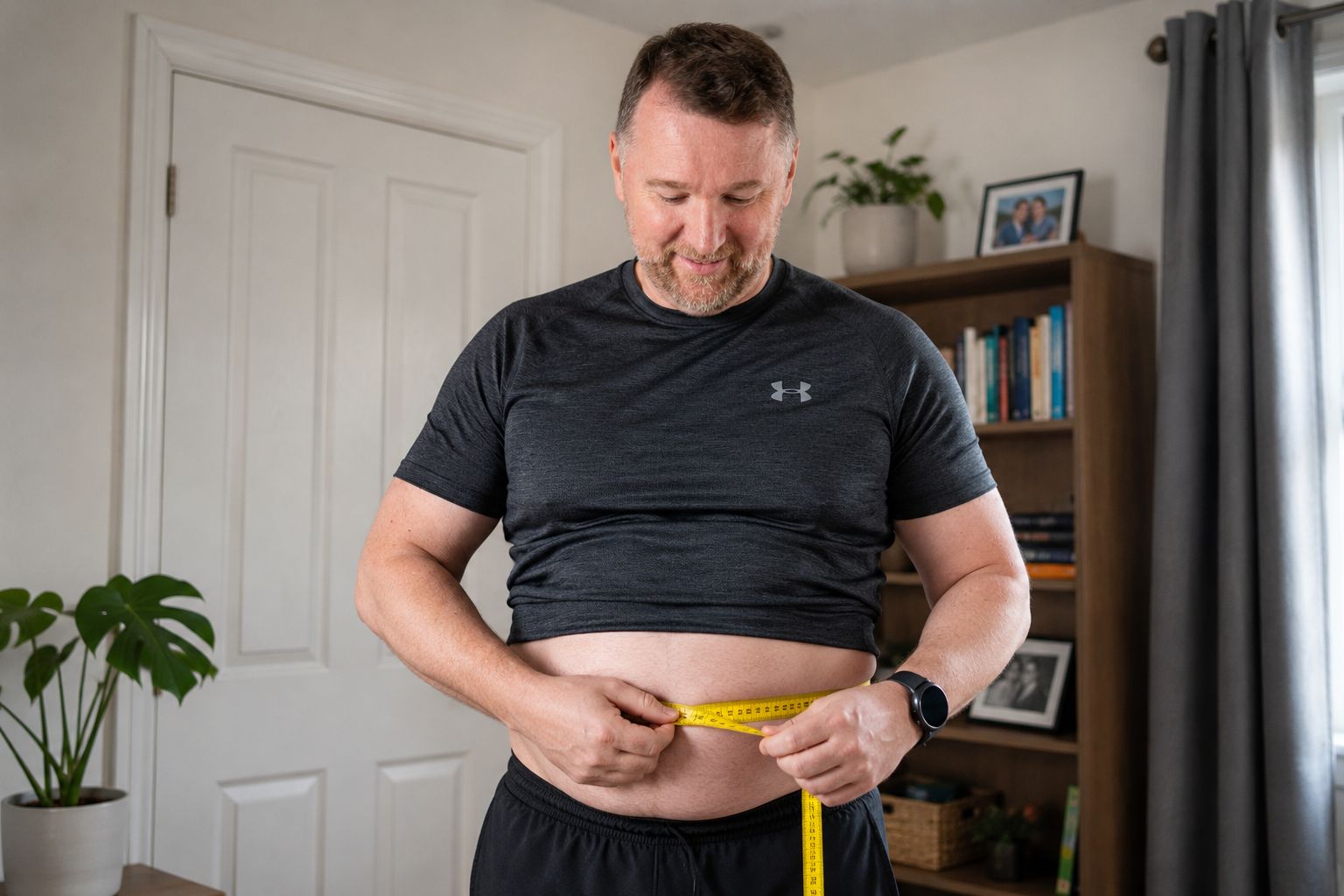
Waist circumference. Same tape, same spot, same time of day, every week, and judged as a trend over several weeks rather than any single reading. Alongside a static scale, a shrinking waist is a decent sign fat's coming off, though it's not proof on its own. Carrying more weight round the middle also has knock-on effects for posture and back pain, which I've covered separately if that's something you notice too.
Training numbers. Lifting more, or doing more reps at the same weight, shows your performance is moving forward. It doesn't prove you've built muscle by itself, strength can improve through getting better at the lift before any tissue changes, but it's still a good sign things are heading the right way.
Resting heart rate and blood pressure. These often move in the right direction alongside fitness and body composition changes. They're a separate marker of health rather than proof of fat loss, but they're worth having on the list either way.
How your clothes fit round the middle. Crude, but it's telling you something the scale genuinely can't.
And when you do use the scale, treat it as a trend rather than a verdict. Weigh under similar conditions and look at the weekly average, not any single number.
When a flat scale actually is a problem
Recomposition doesn't last forever. Stay in a genuine calorie deficit for long enough and fat loss will eventually outpace anything you're gaining in muscle, glycogen and water. When that happens, the scale starts moving. That's exactly what you'd expect, and it doesn't contradict anything above, it's just what happens once the early adaptations settle down.
So here's the practical checkpoint I use, with clients and with myself right now, not a scientific threshold, just a sensible point to stop assuming and start checking. If your waist keeps coming down and your training keeps moving forward while the scale sits still, there's no reason to panic or cut calories further. But if you get to six to twelve weeks with neither your average weight nor your waist properly shifting, that's the point to review the plan. Check whether what you're logging actually matches what you're eating. Check whether daily activity outside training has quietly dropped off. Check whether your tracking method, scales, tape measure, or bioimpedance, has started giving you noisy numbers.
Rob Ede, health first personal trainer and Level 4 nutrition coach at Lightwater Leisure Centre.
If you want a proper look at where you're at, waist, training numbers and the rest, that's exactly the kind of thing I go through with clients starting the Prime Health Programme. You can read more about the programme at edefitness.com, or just email me at [email protected] if you want a second opinion on your own numbers.
Related reading
Creatine After 40: The Evidence, including why creatine can add its own water weight wrinkle to the scale if you're taking it alongside training.
Does Belly Fat Cause Back Pain? What the Evidence Says About Anterior Pelvic Tilt, if carrying weight round the middle is also affecting your posture or back.
References (for the curious)
Stiegler P, Cunliffe A. The role of diet and exercise for the maintenance of fat-free mass and resting metabolic rate during weight loss. Sports Medicine. 2006;36(3):239 to 262.
Barakat C, Pearson J, Escalante G, Campbell B, De Souza EO. Body Recomposition: Can Trained Individuals Build Muscle and Lose Fat at the Same Time? Strength and Conditioning Journal. 2020;42(5):7 to 21.
Moderators of Resistance Training Effects in Overweight and Obese Adults: A Systematic Review and Meta-analysis. Medicine and Science in Sports and Exercise. 2022.
Olsson KE, Saltin B. Variation in total body water with muscle glycogen changes in man. Acta Physiologica Scandinavica. 1970;80(1):11 to 18.
Damas F, Phillips SM, Libardi CA, et al. Resistance training induced changes in integrated myofibrillar protein synthesis are related to hypertrophy only after attenuation of muscle damage. Journal of Physiology. 2016;594(18):5209 to 5222.
Damas F, Phillips SM, Lixandrão ME, et al. Early resistance training-induced increases in muscle cross-sectional area are concomitant with edema-induced muscle swelling. European Journal of Applied Physiology. 2016;116(1):49 to 56.
Medical disclaimer: This article is for general information and education only and is not a substitute for personalised medical advice, diagnosis or treatment. I am a qualified personal trainer and nutrition coach, not a doctor. Always consult an appropriate healthcare professional before making significant changes to your exercise, nutrition or medication, particularly if you have a medical condition, are pregnant, or take prescription medication.
Copyright © 2026 Rob Ede. You may quote brief excerpts from this article provided you include appropriate attribution and a link to the original. Please do not reproduce or republish the article in full without written permission.