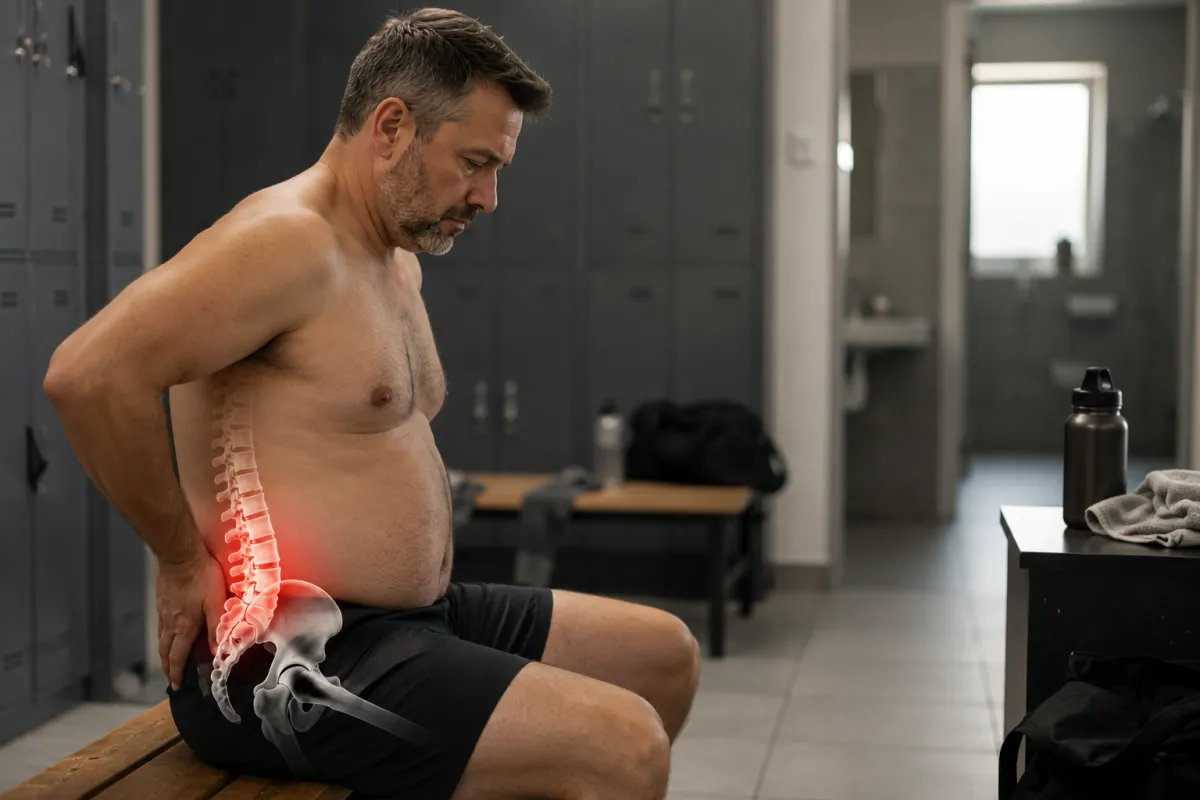
Does Belly Fat Cause Back Pain? What the Evidence Says About Anterior Pelvic Is your belly wrecking your back? The truth about posture, fat, and pain
Is your belly really wrecking your back? What the evidence says about belly fat, posture and pain
You've caught sight of yourself side-on in a mirror or a holiday photo. Belly forward, lower back arched, and somewhere along the way someone has told you that tilt is a defect. A "fault" that's grinding your spine down and causing your back pain. The unspoken conclusion is grim: you're structurally broken, and there's nothing you can do about it until you lose the weight, which you've been trying and failing to do for years.
It's a tidy story. It's also one the evidence doesn't really back up. The forward tilt is real and the physics behind it is real, but the leap from "tilted pelvis" to "this is why your back hurts and you're falling apart" is where the science quietly falls over. If you're carrying weight around the middle and worrying your posture is a ticking clock, this one's worth ten minutes.
The mechanism is real, so let's give it its due
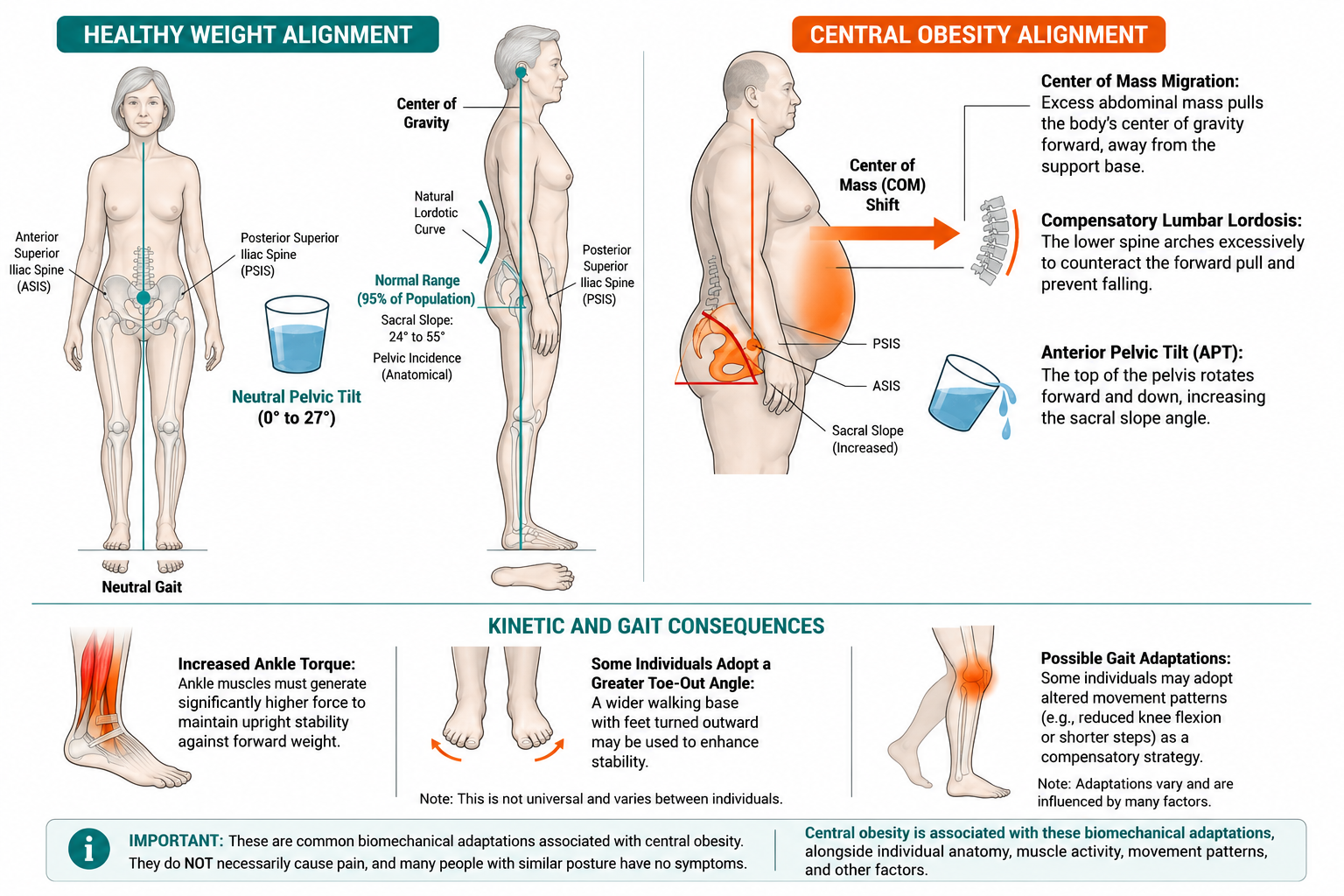
When you carry extra mass around the abdomen, it sits in front of your spine and pulls your centre of gravity forward. Your body won't let you topple, so it counterbalances: the lower back arches a little more (increased lumbar lordosis) and the pelvis rotates forward at the top. That forward rotation is anterior pelvic tilt. It's the body keeping your head stacked over your feet so you can stand and walk without pitching over.
Picture the pelvis as a bucket of water held at your hips. Load the front and it tips forward, and a little spills out the front. That's the tilt the infographics love to draw, and it's a fair description of what's happening mechanically. Research in people carrying abdominal weight does show this pattern, and there's a decent argument that the extra arch is partly a deliberate strategy the body adopts to manage the load, not just a passive sag.
So far, so sensible. Here's where the popular story goes wrong.
"Adaptation" is not the same as "defect"
A successful adaptation and a structural fault are two very different things, and the fitness industry routinely confuses them. Your pelvis tilting to keep you upright under load is the system working, not the system breaking.
The honest question is whether that tilt actually causes pain. And here the data is a lot softer than the confident diagrams suggest. A 2024 systematic review pooling 36 studies, more than 3,600 people with back pain against several thousand without, found that pelvic tilt was, on average, slightly higher in the back-pain group. That sounds like a smoking gun until you read the small print. The effect was modest, the study quality was mixed, and crucially it's all cross-sectional. Everyone was measured at a single point in time. That means it cannot tell you which came first. Did the tilt cause the pain, or did the pain change how people stand? Both are entirely plausible, and pain is very good at altering posture.
Step up to the bigger clinical guidelines and the picture gets clearer. The 2020 North American Spine Society guidelines, one of the most thorough evidence reviews going, rate body weight as a predictor of recurring back pain as "Grade I", which is their term for insufficient evidence. Even visible wear on an X-ray (the spondylosis that shows up in most of us past 40) has an "insufficient" association with whether someone is actually in pain. If genuine structural changes on a scan don't reliably predict pain, a few degrees of pelvic tilt almost certainly don't either.
What actually predicts whether back pain sticks around
This is the part the posture obsession misses entirely. When researchers look at what turns a short-lived bout of back pain into a chronic, life-limiting one, the strongest predictors (Grade A evidence, the good stuff) aren't structural at all. They're things like fear of movement, low mood, job dissatisfaction and how much the pain is affecting you early on.
There's a cruel irony in there. Tell a stressed 50-year-old that their posture is a "defect" causing their pain, and you've handed them a reason to stop moving, to brace, to avoid the gym, to wait until they've "fixed" themselves before they dare exert. That fear and avoidance is itself one of the biggest drivers of long-term disability. The label does more damage than the tilt.
"But I can see my belly pulling me forward"
Fair. You can. I'm not going to pretend the mechanics aren't happening, because they are. But seeing the adaptation isn't the same as proving it's your pain generator.
You'll also hear that your tilt comes from "tight hip flexors and weak glutes", usually under the banner of Lower Crossed Syndrome. It's a neat model and it sells a lot of corrective programmes. It also isn't part of any evidence-based diagnostic criteria for back pain. Muscles do change how they fire under load, but the idea that a fixed muscle imbalance is yanking your pelvis into a permanent, painful position is a fitness-industry story, not a clinical finding. I'd want to see far better data before I'd build your whole programme around "fixing" it.
Three things you can stop worrying about
"My scan will find the cause." Usually it won't. Most back pain is classified as nonspecific, meaning no single structure explains it, and imaging in the absence of warning signs tends to turn up incidental findings that don't match the pain. UK guidance is clear that routine scans aren't the answer for ordinary back pain.
"I need special core stabilisation drills first." The evidence puts specific stabilisation work as roughly equivalent to general exercise, not superior. You don't need a clever corrective sequence before you're allowed to move. General activity does most of the job.
"I have to lose the weight before I can start." This is the one that keeps people stuck for years. Losing visceral belly fat is genuinely worth doing: it's good for your heart, blood pressure, blood sugar and energy, it takes load off your spine, and it often eases symptoms. What's far less settled is whether it directly changes your pelvic alignment. There's currently insufficient evidence that weight loss alone reliably normalises pelvic posture or resolves nonspecific back pain. So lose it for those reasons, but don't sit on the sidelines waiting for it to happen before you move.
What's actually worth doing
The interventions with the strongest evidence for back pain are refreshingly unglamorous, and none of them involve obsessing over your pelvic angle.
The guideline gives a Grade A recommendation for aerobic exercise to improve pain, disability and mood in the short term. Plain cardio. Walking, cycling, rucking, whatever you'll do regularly. Structured education combined with exercise (the "back school" approach) gets a Grade A recommendation too, and beats standard medical care at six to twelve months. Staying active inside your pain limits beats bed rest, every time. And general strength work keeps you capable: adults gradually lose muscle mass with age, and the losses accelerate from around the fifth decade unless resistance training helps preserve it. It also builds the resilience that lets you carry on regardless of what your pelvis is doing.
A quick safety note, because it matters. Most back pain is benign and settles. But unexplained weight loss, fever, numbness around the saddle area, loss of bladder or bowel control, or persistent or worsening neurological symptoms are red flags that need a doctor, not a workout. If pain is severe, persistent or you're not sure what you're dealing with, a proper assessment from a musculoskeletal physio is the sensible first call. Locally, Physica Health in Bagshot are a masters-qualified clinic who handle exactly this, and they're who I'd point you toward.
The real risk isn't the tilt
Here's what I'd say to you if you were stood in front of me at Lightwater. The thing most likely to hurt you over the next decade isn't a few degrees of pelvic tilt. It's the spiral that starts when someone convinces you you're broken: you tense up, you stop moving, you decondition, the pain settles in, and a problem that was never structural becomes a genuine limit on your life. That spiral is preventable, and it's reversible.
What breaks it is straightforward, structured movement done consistently, matched to a body that's 45 or 55 rather than 25. That's the whole of what I do with the busy professionals I coach across Lightwater, Bagshot and Windlesham: two or three focused PrimeFit sessions a week that build aerobic fitness and real strength, without the corrective-exercise theatre. If your back's been the reason you keep putting off getting started, that's precisely the thing worth getting a proper plan for, not another reason to wait.
If you're weighing up whether it's even worth getting help with this rather than working it out alone, that's a fair question, and one I've answered properly elsewhere: is personal training worth it after 50? goes through what you're actually paying for at this stage of life, and when it isn't worth it. The short version is that the value was never someone counting your reps. It's in not wasting the limited training time you've got on the wrong things, like chasing a pelvic tilt that was never the problem in the first place.
If you want a hand mapping that out, book a diagnostic consultation at Lightwater Leisure Centre and we'll work out where you actually are and what'll move the needle. You can start at edefitness.com or email me directly at [email protected].
References (for the curious)
North American Spine Society (2020). Evidence-Based Clinical Guidelines for Multidisciplinary Spine Care: Diagnosis and Treatment of Low Back Pain. NASS.
Sannasi R. et al. (2024). Postural asymmetry in low back pain: a systematic review and meta-analysis of observational studies. Disability and Rehabilitation. https://www.tandfonline.com/doi/full/10.1080/09638288.2024.2385070
Vismara L. et al. (2010). Effect of obesity and low back pain on spinal mobility: a cross-sectional study in women. Journal of NeuroEngineering and Rehabilitation. https://pmc.ncbi.nlm.nih.gov/articles/PMC2821381/
Fernández-Rodríguez R. et al. (2024). Effectiveness of physical activity in the management of nonspecific low back pain: a systematic review. https://www.ncbi.nlm.nih.gov/pmc/articles/PMC11678838/
National Institute for Health and Care Excellence (NG59). Low back pain and sciatica in over 16s: assessment and management. https://www.nice.org.uk/guidance/ng59