
How Many Days a Week Should You Strength Train After 50?
For most people over 50, two well-run strength sessions a week are enough. Not a consolation prize, not the least you can get away with. Enough. When researchers have looked specifically at older adults, two sessions a week is roughly where the returns start to flatten out. Three can do a bit more, in specific situations. Four or more is rarely necessary, though not automatically too much. There's no single right number: it depends on how long you've been training, how well you recover, and what you're actually chasing. This piece is about picking yours.
If your real question is the broader one, how much exercise you need after 50 in total, I've answered that separately in the wider guide to how much exercise you actually need after 50, which covers the aerobic side and the general activity guidelines. This article is narrower. Just the strength half, and just the frequency question: how many days.
Why two is a real answer, not a soft one
Here's the bit the "more is more" crowd skips. For building and keeping muscle, the variable that does most of the work isn't how many days you train. It's how much hard work you do per muscle across the week (your weekly volume, meaning challenging sets), and how heavy those sets are. Frequency is mainly how you package that work.
When studies hold weekly volume constant and only change the number of days, training frequency doesn't meaningfully change muscle growth. Spread the same sets over two days or four and the muscle responds about the same, so you can largely choose your frequency by preference and logistics. Where two days helps, it isn't that twice-weekly is inherently better than once. It's that two sessions often make your weekly volume and your movement practice easier to distribute than trying to fit everything into one. And once a week can still produce meaningful improvements, particularly for beginners, people who've been detrained for a while, and some older adults. It simply leaves less room to spread productive work across the week.
When researchers zoom in on older adults, two sessions a week keeps coming up as a strong setting. A meta-analysis of adults over 60 found that adding training days gave only a small extra bump in maximum strength and no further benefit for muscle size, leading the authors to conclude it's unlikely more than two weekly sessions offers older adults much more. A separate dose-response review of healthy older adults identified two sessions a week as one of the most effective single settings for strength.
So if you do two proper sessions, cover every major muscle group, work hard enough to matter, and add a little load or a few reps over time, you are not doing a watered-down version of the real thing. That is the real thing.
If you plateau on two days a week, frequency is only one possible cause, and often not the main one. A stall can come from not adding load or reps over time, too little hard work across the week, under-recovery, patchy or inconsistent training, a programme that isn't well structured, or, in some cases, a frequency that no longer fits your training. Frequency is worth reviewing, but it's rarely the first thing to change.
When three is the better call
Three isn't better because it's more. Three is better when it solves a specific problem two can't.
The clearest case is volume delivery. There's an amount of hard work a muscle needs each week to keep progressing, and past a point you can't fit it all into two sessions without those sessions becoming long, brutal, and slow to recover from. Splitting the same work across three shorter sessions keeps each one crisp and leaves you fresher between them. For a lot of over-50s, three tidy 35-minute sessions sit better than two savage hour-long ones.
There's also a modest strength-specific signal. In the wider resistance-training research, which isn't specific to over-50s, gains in strength on its own (rather than muscle size) do tend to nudge up a little with frequency, with clear diminishing returns. If your goal is specifically to get stronger, more practice at the movement helps, because strength is partly a skill. Three gives you more reps at that skill.
Pick three if you want more overall volume without punishing single sessions, if you're chasing strength as a priority, or if you simply prefer training more often in smaller doses. It's a preference-and-goal decision, not an obligation.
Is four or more ever worth it after 50?
It can be, for the right person, and it isn't inherently too much. It's just rarely necessary for the typical reader.
Four-plus sessions mainly make sense as a way to slice your weekly work into shorter, more frequent, more specialised chunks, the kind of upper/lower or body-part splits a dedicated lifter runs. If you're an experienced trainee who recovers well, sleeps properly, has the time and enjoys being in the gym often, there's nothing wrong with it, provided your weekly volume and recovery are managed sensibly rather than just piled higher.
The catch is that for most busy professionals over 50, the limiter isn't enthusiasm. It's recovery and time. Adding a fourth or fifth day only adds results if the extra work is hard, well-recovered and progressing. Stack more sessions on top of poor sleep and a demanding job without adjusting the load, and you tend to accumulate fatigue and nagging aches rather than progress. More days is not the same as more progress. For most people reading this, the honest answer to "should I train four-plus days?" is: only if two or three are already going well and you actively want to, and only if you keep an eye on total volume and recovery.
It depends where you're starting from
The right number shifts with your training history more than your age.
If you're a beginner, two full-body days are a sensible starting point for most beginners. Early on, your strength climbs quickly, largely because your nervous system is learning the movements, so you don't need much volume to progress. What you need is practice with good technique and a recovery capacity you haven't built yet.
If you're experienced, you've earned the option of three (or a sensible four), you can handle more volume, and you know your own recovery well enough to judge it. You'll likely need the extra work to keep progressing, because the fast early gains are behind you.
If you're coming back after a long break, you have one advantage and one trap. The advantage: people returning to training often regain their previous strength and fitness faster than it took to build the first time, so the early weeks can move quickly. The trap: it's easy to jump straight back to the frequency and loads you used years ago, before your tolerance for that work has been re-established. A more reliable approach is to restart around two days and rebuild gradually, letting your capacity catch up before you chase the old numbers, even if the first sessions feel easy.
Full-body or a split? Match it to your days

A useful working principle after 50: aim to train each major muscle group about twice a week. That single guide sorts out most of the full-body-versus-split question for you.
At two days, that means full-body both times. Two full-body sessions cover everything twice, which is the best use of limited days. It's also why the old "one body part per day" split is usually a poor fit at two or three days a week: it tends to hit each muscle only once, and once a week is generally not the most productive way to train a muscle for growth.
At three days, full-body each time still works well and stays simple, or you can rotate so everything gets worked across the week. At four days, an upper/lower split (upper body twice, lower body twice) becomes clean and lets each session go a little deeper without dragging on. Notice what these share: everything trained roughly twice. Choose the structure that delivers that inside the number of days you're actually doing.
Recovery shapes how you arrange the week
How much recovery you need between sessions isn't a fixed number, and it's a mistake to treat any single figure as a rule. It depends on how much hard work you did, which exercises, how close to failure you pushed, whether your next session trains the same muscles, and on your experience, sleep, nutrition, stress and individual response. Two light, technique-focused sessions barely dent you; two heavy, high-volume ones asking a lot of the same muscles need more room.
A sensible working approach for most people over 50 is to give a muscle group you've trained hard a little time before you load it hard again, and to arrange the week so you arrive at each session recovered enough to train well. That doesn't rule out training on back-to-back days. Consecutive-day training is perfectly workable when the programme is built for it, for instance by alternating which muscles you load so the same ones aren't worked hard two days running. The principle isn't a magic rest interval. It's simple: structure the week so you can train each session properly, and adjust when you can't.
What should nudge your number up or down
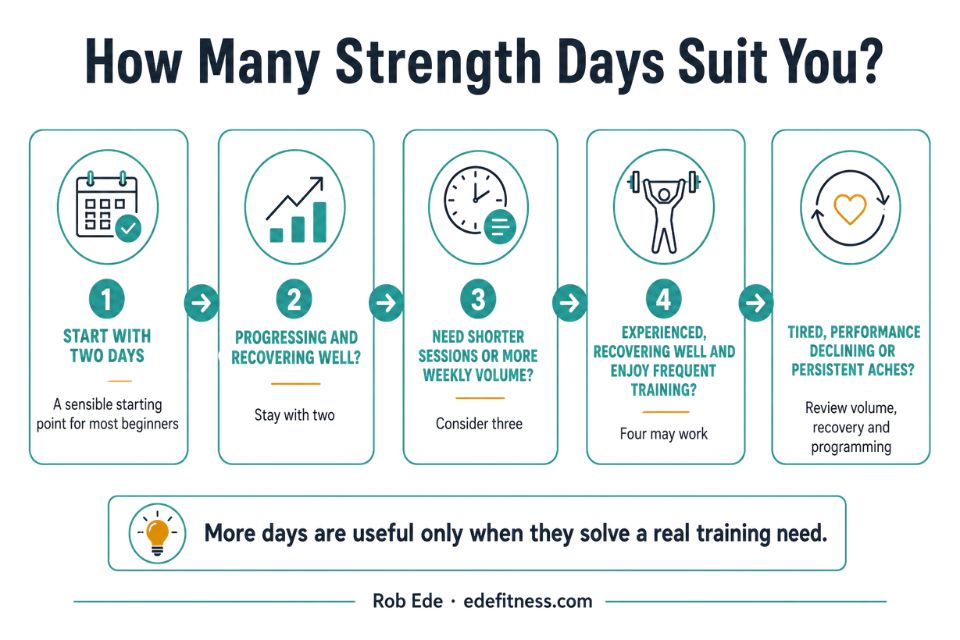
A few real-world factors move the answer:
Intensity and volume. Harder, higher-volume sessions demand more recovery, which usually means more space between them, not necessarily more of them. If you train heavy, two well-spaced days can be plenty.
Sleep and stress. These are recovery. If you're running on six broken hours and a punishing week, that's not the moment to add a training day, that's the moment your existing sessions need more room. Adding frequency to compensate for poor recovery is a common way capable people stall themselves.
Existing injuries. A cranky knee, shoulder or lower back can dictate your frequency more than any study. Sometimes the answer is more frequent, lighter, targeted work; sometimes it's fewer, better-planned sessions that train around the problem. If a specific injury is deciding your schedule for you, it's worth getting it properly assessed by a suitable healthcare professional rather than guessing.
Signs your training dose or schedule needs reviewing
Your training tells you more than any rule of thumb, so watch the objective markers rather than how you feel on a given day.
Signs you may be training too often for your current recovery: your loads and reps stall or start drifting backwards, your technique degrades as sessions go on, you're persistently fatigued, your sleep is disrupted, or aches linger and don't settle between sessions. If adding days stopped bringing any improvement a while ago and progress has gone flat or negative, more frequency isn't the fix.
Signs you may not be training enough to drive change: your loads and reps aren't progressing over a run of weeks, sessions never feel challenging even when you try to push them, and your performance is flat. Stalled progress on its own doesn't prove you need more training days, though: it may equally reflect effort, progression, weekly volume, consistency, recovery or programme design, so rule those out before adding a session. Judge this by whether your numbers are trending up over time, whether your technique is holding, and whether you're training consistently, not by whether you felt sore afterwards. Soreness is an unreliable guide: you can make excellent progress with very little of it, and plenty of it without making any.
The target is the smallest number of days that still lets you progress and recover well. If your loads and reps are trending up and you're recovering between sessions, you've got it right, whatever the number.
Two example weeks
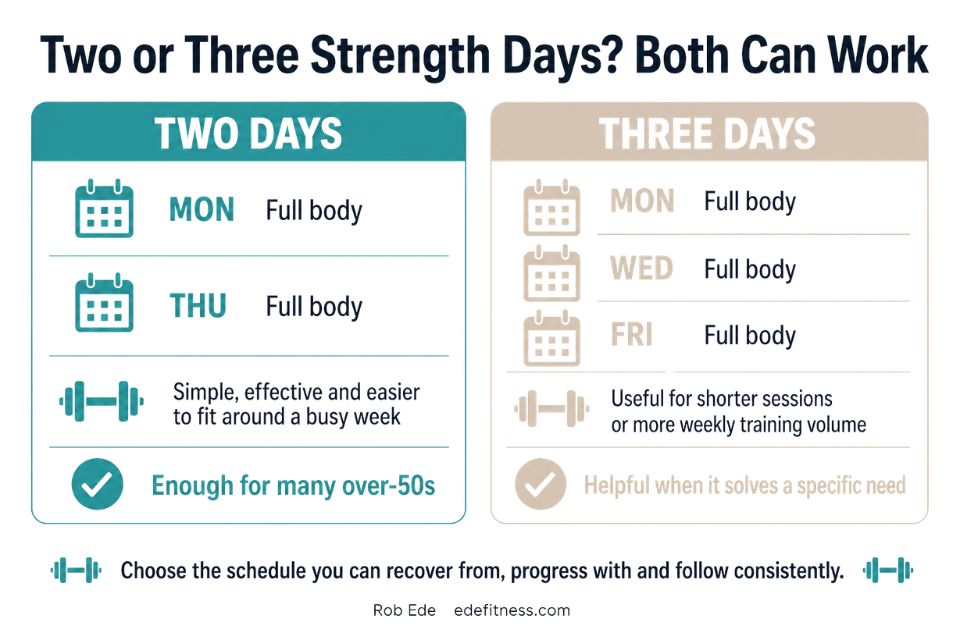
A two-day plan. Train Monday and Thursday, full-body each time, built around a handful of big compound movements (a squat or leg-press pattern, a hinge, a push, a pull), loaded properly and nudged up over time. That leaves three clear days between sessions on one side and two on the other. Everything trained twice. This is the busy-professional default, and it works.
A three-day plan. Train Monday, Wednesday and Friday, with the weekend clear. You can keep all three full-body, or lean one session slightly more toward lower body and another toward upper if you want a touch more focus, as long as everything still gets worked across the week. Each session can be shorter than on the two-day plan because the work is spread out, which many people find easier to recover from. A day's gap between each keeps the week manageable.
Neither is fancy. Both beat five scattered days you can't recover from.
The number matters less than what you do with it
Pick the smallest number of days that lets you keep progressing and recovering. For most people over 50, that's two done properly, or three if you want more and can recover it. Getting the frequency right is the easy part. The harder part, and the part that mostly decides your results, is whether those sessions are heavy enough to matter, technically sound enough to be safe, and progressed sensibly over time. Two precise sessions will usually out-perform four sloppy ones.
That precision is difficult to self-manage, and it's a fair reason to get a coach involved: not motivation, but making sure the two or three days you're already willing to give actually pay off. If you'd like your number worked out around your training history, your recovery and any niggles, meet me for a free consultation. There's no pressure and nothing to pay: we sit down, look at where you are, and map what staying strong into your sixties would realistically take. You can book at edefitness.com, or email me directly at [email protected].
Rob Ede is a health-first personal trainer and Level 4 nutrition coach based at Lightwater Leisure Centre.
Medical disclaimer: This article is for general information and education only and is not a substitute for personalised medical advice, diagnosis or treatment. I am a qualified personal trainer and nutrition coach, not a doctor. Always consult an appropriate healthcare professional before making significant changes to your exercise, nutrition or medication, particularly if you have a medical condition, are pregnant, or take prescription medication.
Related reading
How Much Exercise Do You Actually Need After 50?— the broader guide to total exercise after 50, including the aerobic side and where strength fits in.
Is a Personal Trainer Worth It After 50? Here's What You're Really Paying For — the honest case for (and against) getting a coach.
References (for the curious)
Schoenfeld BJ, Grgic J, Krieger J. How many times per week should a muscle be trained to maximize muscle hypertrophy? A systematic review and meta-analysis of studies examining the effects of resistance training frequency. J Sports Sci, 2019. https://pubmed.ncbi.nlm.nih.gov/30558493/
Schoenfeld BJ, Ogborn D, Krieger JW. Effects of Resistance Training Frequency on Measures of Muscle Hypertrophy: A Systematic Review and Meta-Analysis. Sports Med, 2016. https://link.springer.com/article/10.1007/s40279-016-0543-8
Kneffel Z, Murlasits Z, Reed J, Krieger J. A meta-regression of the effects of resistance training frequency on muscular strength and hypertrophy in adults over 60 years of age. J Sports Sci, 2021. https://www.tandfonline.com/doi/abs/10.1080/02640414.2020.1822595
Borde R, Hortobágyi T, Granacher U. Dose-Response Relationships of Resistance Training in Healthy Old Adults: A Systematic Review and Meta-Analysis. Sports Med, 2015. https://pubmed.ncbi.nlm.nih.gov/26420238/
Pelland JC et al. The Resistance Training Dose-Response: Meta-Regressions Exploring the Effects of Weekly Volume and Frequency on Muscle Hypertrophy and Strength Gain. 2025. https://pubmed.ncbi.nlm.nih.gov/41343037/ (general resistance-training evidence; not specific to adults over 50)
Copyright © 2026 Rob Ede. You may quote brief excerpts from this article provided you include appropriate attribution and a link to the original. Please do not reproduce or republish the article in full without written permission.