Is Processed Food Bad for You? What My Clients’ Food Diaries Reveal
Every week I sit down and go through my clients' food diaries, and it's honestly one of the most useful parts of the coaching. A diary shows me what people are actually eating rather than what they think they're eating, and it reveals the habits behind the choices, which is usually where a few practical changes make the biggest difference.
This week, one breakfast was eggs and wholemeal toast, and another was eggs and a banana. Both are perfectly decent starts to the day, and I wouldn't want anyone reading this to think they've been doing it wrong. But when I review a diary I'm looking past whether someone's hit their protein or stayed within their calories. I'm asking where the vegetables are, how much variety there is across the week, and what the rest of the day looks like once you put breakfast alongside lunch, dinner and whatever got eaten at four o'clock.
So, is processed food bad for you? Some of it, if it makes up most of what you eat, but plenty of processed food is perfectly good for you, and the label on its own tells you surprisingly little. Processed food gets a lot of attention at the moment, and fair enough, but for most of the people I coach the more useful question isn't "is this processed?" so much as "what are my meals actually made of, and is there enough variety in there to do me some good?"
Think beyond protein and calories
A lot of the people who come to me are already fairly switched on about food. They've used an app, they know roughly how much protein they're getting and they can probably tell you the calories in a flat white. That's a genuinely good starting point (and protein really does matter more after 40), but macros only tell you part of the story.
Take those eggs. They give you good-quality protein along with a decent spread of vitamins and minerals, so they're a sound base for breakfast. Add a handful of spinach, some mushrooms, a few cherry tomatoes or some sliced peppers and you've got much the same protein with more fibre, more colour and a wider range of nutrients, for about two extra minutes in the pan. The macros barely change, but the meal does.
It's worth knowing how far most of us are from where we should be on this. The latest National Diet and Nutrition Survey found that fewer than one in five UK adults eat their five a day, and analysis of the same data suggests only around 4% of adults reach the recommended 30g of fibre. So when I ask "where are the vegetables?", I'm not being fussy, it's one of the most common gaps I see.
The other thing I'd say is that you don't need every meal to contain everything. Eggs and a banana is fine if lunch is a big salad with some beans in it and dinner has two or three vegetables on the plate. That's why I look at the whole day, and ideally the whole week, rather than marking each meal on its own.
What "processed" actually means
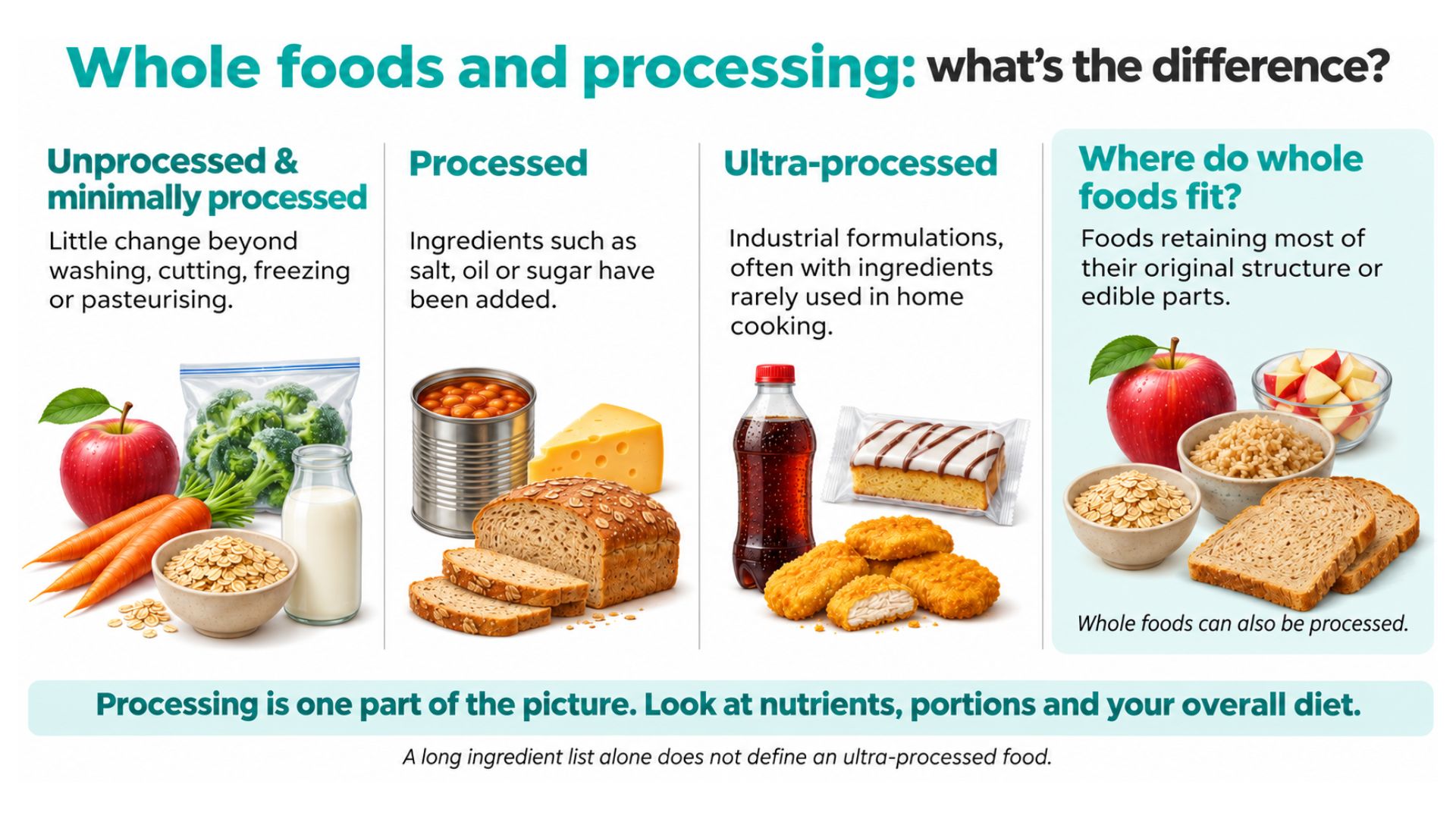
This is where a lot of people get a bit tangled up. Butter is processed, wholemeal bread is processed, and so are frozen peas, bagged spinach and a tin of chickpeas. The NHS describes processed food as anything that's been altered in some way during preparation, which includes freezing, canning, cooking and drying, so almost everything in your kitchen counts.
None of that makes those foods nutritionally equivalent to each other, and it certainly doesn't put them in the same bracket as a packet of biscuits or a ready meal. Researchers often use the NOVA system, which sorts food into four groups: unprocessed or minimally processed foods, cooking ingredients such as butter and oil, simple processed foods such as basic bread and cheese, and finally ultra-processed products made largely from industrial ingredients and additives you wouldn't normally find in a home kitchen.
There's reasonable evidence that a diet heavy in ultra-processed food tends to work against you. In a well-known 2019 trial, people ate around 500 calories a day more on an ultra-processed diet than on a minimally processed one, even though the meals on offer were matched for things like sugar, fat and fibre, and they put on weight during the ultra-processed fortnight while losing weight on the other. A major Lancet series in late 2025 then pulled together a large body of research linking ultra-processed diets with a range of chronic diseases.
To be fair, there are real caveats here. That trial involved just 20 people for two weeks on each diet, much of the wider evidence shows association rather than cause, and the UK still has no agreed official definition of ultra-processed food. Diabetes UK points out, for example, that reduced-sugar baked beans count as ultra-processed even though they're a useful source of fibre and protein. So my view is that packaging and a long ingredients list are clues worth investigating rather than a verdict. If the list includes things you'd never cook with yourself, that's a reason to look more closely, not an automatic ban.
Look at what you're actually buying
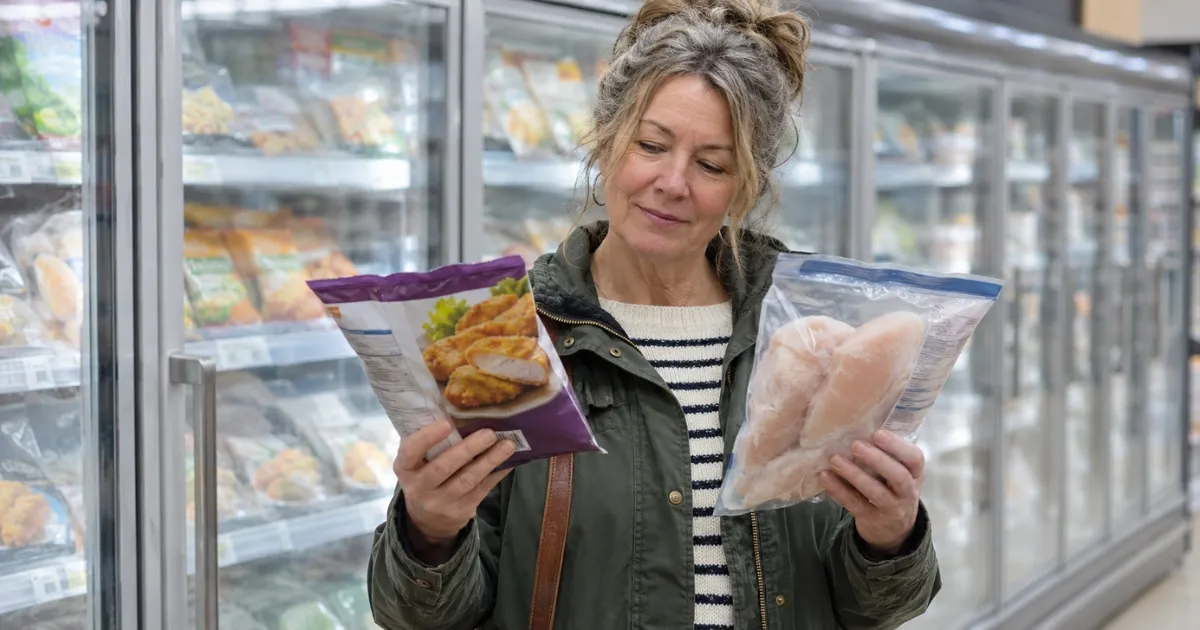
Breaded chicken is a good example of why it's worth turning the pack over. It's sold as a protein food and it often gets logged simply as "chicken", but it isn't all chicken. UK supermarket breaded fillets commonly list chicken at somewhere around 60 to 70% of the product, with the rest being breadcrumb, oil, starch and seasoning, and some say "chicken with added water", which dilutes things a little further. Nuggets and shaped products can be lower still, and consumer testing overseas has found some under 40%.
The questions I'd ask are pretty straightforward. How much of this is actually chicken? How much protein does a serving give me, and how does that compare with a plain chicken breast of the same weight? And what am I getting alongside it in terms of fat, salt and calories?
Coating a chicken breast yourself in a little beaten egg and wholemeal breadcrumbs, then baking it, gives you something with the same appeal but far more chicken per bite and a lot more control over what goes into it. The obvious objection is time, which I completely understand if your week is already full. The answer is doing several at once. Coat six or eight on a Sunday, cook what you need and freeze the rest, and the homemade version ends up about as convenient as the packet.
Build meals around useful foods
Rather than starting from a list of things to avoid, I'd much rather clients start from what each meal is built on. Protein sources, vegetables, fruit, pulses, whole grains and sensible amounts of fats like olive oil, nuts and seeds each bring something different, and a meal that draws on three or four of those is usually in pretty good shape.
Processing is one part of the picture, but it isn't the whole picture. You can eat almost entirely whole foods and still get the balance wrong, say with a plate that's mostly pasta with very little alongside it, or with handfuls of nuts and cheese that quietly add up to far more than you'd realise. Getting the balance and the portions right matters just as much as how processed something is.
This is where the food guide I give clients comes in. It's a useful starting point, but following a list isn't quite the same as putting together a balanced diet, and the diary is how we close that gap. I'll see what someone's actually eating, point out where a meal could be doing a bit more work, and we'll change one or two things at a time rather than overhauling everything on a Monday morning and hoping it sticks.
Make room for enjoyment
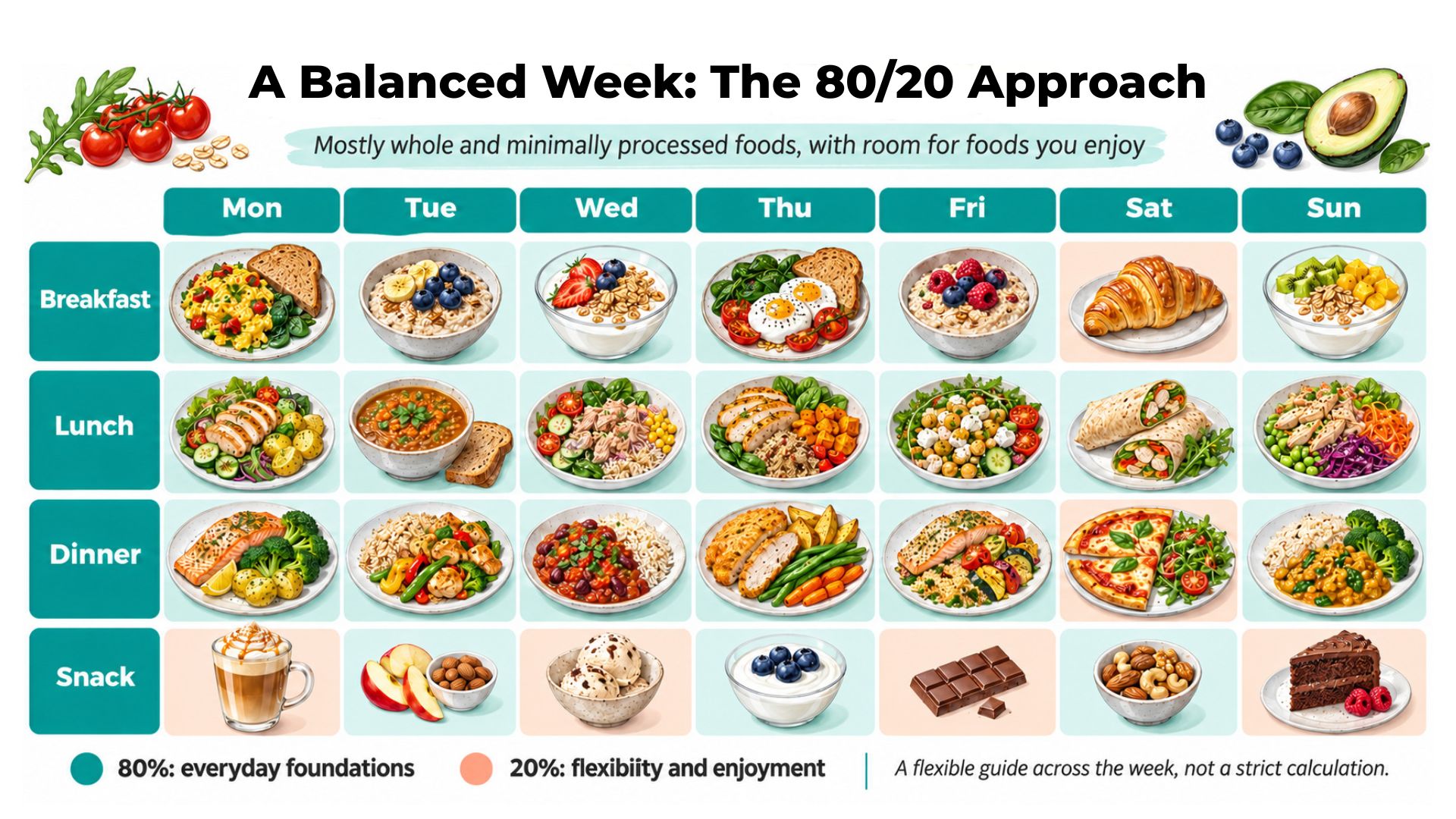
I'm not aiming for clients who never eat a biscuit again. I work to roughly an 80% approach, where most of what you eat is whole or minimally processed and built around those useful foods, and the rest leaves room for meals out, a takeaway on a Friday or a slice of cake at a family birthday. Honestly, that's the version that lasts, because rules that expect every mouthful to be perfect tend to fall apart within a few weeks and leave people further back than where they started.
Where to go from here
If you've been tracking your protein and calories carefully, that's good work and it's worth keeping up. But it might be worth looking a bit more closely at what actually makes up your meals. Pull up the last few days of your diary or app and ask the same questions I would: where are the vegetables, how much variety is there, and which foods are doing most of the heavy lifting?
If you'd like someone to go through that with you, reviewing food diaries and helping people build meals that fit their week is a regular part of how I coach on the PrimeFit Programme. You can book a free consultation here, or just drop me a line at [email protected].
Rob Ede is a health-first personal trainer and Level 4 nutrition coach at Lightwater Leisure Centre.
Related reading
You Probably Do Eat Quite Well. That Might Not Be the Problem.
What Does a Nutrition Coach Actually Do, and Are You Making the Most of Yours?
References (for the curious)
Office for Health Improvement and Disparities / FSA. National Diet and Nutrition Survey 2019 to 2023 report
The Food Foundation (2025). UK still failing to meet basic dietary guidelines
Hall KD et al. (2019). Ultra-processed diets cause excess calorie intake and weight gain: an inpatient randomized controlled trial of ad libitum food intake. Cell Metabolism.
Monteiro CA et al. (2025). Ultra-processed foods and human health: the main thesis and the evidence. The Lancet.
British Nutrition Foundation (2025). Lancet series on ultra-processed foods
Dicken SJ, Batterham RL, Brown A (2024). Nutrients or processing? An analysis of food and drink items from the UK National Diet and Nutrition Survey. British Journal of Nutrition.
Diabetes UK. Processed foods
Consumer NZ. How much chicken is in frozen nuggets, tenders and burgers?