Hybrid Coaching: The Best of Personal Training and Online Coaching
Most people picture personal training as an hour in the gym. You turn up, you train, the trainer pushes you harder than you'd have pushed yourself, then the hour ends.
Online coaching works differently. You get a programme through an app, some nutrition guidance, regular check ins. You might never actually meet your coach.
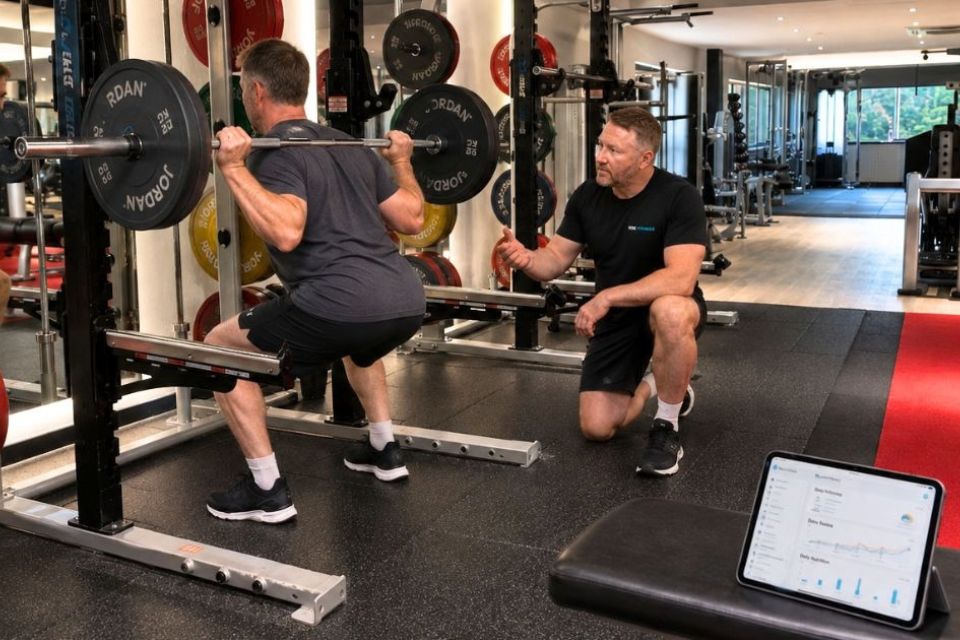
Neither format on its own gets you everything. Hybrid coaching isn't the two stitched together. It's a feedback loop: what happens in the gym shapes what happens the rest of the week, and what happens the rest of the week shapes what we do in the gym.
That's the model I use in my PrimeFit programme
Traditional PT: are you buying coaching, or an hour?
At most commercial gyms, PT is sold in blocks. Five sessions. Ten sessions. An hour at a time. Plenty of good trainers work inside that model, and this isn't a criticism of them. I worked in that model at a commercial gym myself. Clients pay up front, and I would get paid a small percentage for each session delivered.
Where a trainer is paid mainly for delivering sessions, the business model naturally rewards session delivery, the hour in front of the client, rather than the programming, tracking and support that happen between sessions. That's a feature of how the work is priced, not a comment on any individual trainer's ability. You turn up, you train, the session ends, on to the next client. Some trainers working in this model barley have time to nip to the loo between sessions and work crazy hours to make ends meet. For the client it keeps the headline price low, but problem is that price and good value aren't automatically the same thing.
The real question is what happens outside that hour. Has anyone worked out where you actually are and where you want to get to? Is there a programme behind the workout, or are you just doing something hard with no plan attached to it? Does your trainer know what you're doing the rest of the week? What happens when work gets busy and you miss two sessions? What happens when something starts hurting?
If you want guidance an for one hour a week, traditional PT does that job fine. It just isn't the same thing as being coached.
Online coaching fixes part of that problem
A decent online coach gives you a structured programme, tracks your training, helps with nutrition, reviews progress and holds you accountable between sessions. For many people that's more comprehensive than an hour in the gym, and it's convenient. You train on your own schedule and your coach doesn't need to live down the road.
The constraint is physical, not a question of how good the coach is. A screen shows one angle, usually only during the set itself, not how you naturally move when you walk in, warm up or reset between reps. Small compensations, and the fatigue that builds across a session, are easier to catch from a few feet away with the option to move around than from a single fixed camera position. A video helps. It isn't the same as being in the room.
I was once approached on the gym floor by a young woman following an online coaching plan. She showed me the squat exercise she as doing, and it was immediately obvious to me she had been injured. When I questioned her about it it turn out she was still having physiotherapy for the injury. When I asked her if her physio and or coach were working together it became clear they weren't. This put her at risk of doing something that could cause further injury, because she hadn't provided all the necessary information to the two professionals that she'd asked to help her.
There's a relationship piece too, one that builds slowly and mostly in person. When I train someone regularly I know when they're having a good day, when they're tired, when something doesn't look right, and when they can push harder than they think they can. That judgement comes from time spent watching someone train. You just can't get that from a few voice notes on WhatsApp no matter how good a coach you are.
One feedback loop, not two services
Hybrid coaching isn't personal training with an app added on. It's a single feedback loop running in both directions.
What I see and measure in person, how you move and where technique breaks down under load, shapes the programme you follow independently for the rest of the week. What gets recorded between sessions, the weights you've lifted and the sessions you've missed, shapes what we do together next time you're in front of me.
Neither half works properly on its own. A programme built without in-person observation is guesswork dressed up as data. In-person sessions with nothing tracked between them are just a series of good hours with nothing joining them up.
It starts with A and B
Coaching starts with two questions. Where are you today? That's point A. Where do you want to be? That's point B.
Maybe you want to lose 15kg. Maybe you've noticed you're getting weaker as you get older. Maybe a blood pressure reading was the wake up call. Maybe you want to run a 10K. Maybe you just want to get off the floor, carry your shopping and climb stairs without feeling like you're ageing faster than you should be.
Once I understand A and B, my job is working out the route between them. That's usually some blend of strength training and cardiovascular work, matched to the time you've actually got and enough consistency to make it stick. I'm not selling workouts. I'm solving a problem you brought to me.
A workout isn't a programme
Making someone tired is easy. Burpees and an assault bike, and you'll leave wrecked, guaranteed. Exhaustion isn't evidence of good coaching. It's evidence you can be made tired.
Fatigue and adaptation aren't the same thing. Feeling wrecked tells you the session was hard, not that your body has actually adapted and got stronger. Real adaptation needs the stimulus to progress over time, in a way you can recover from and build on, not the same exhausting session repeated on a loop.
A proper programme progresses. It gives enough stimulus to improve without grinding you into the ground every session, and it accounts for your ability, training history, injuries, available time and preferences. It has to evolve too. If you're getting stronger it needs progressing. If something isn't working it needs changing. If you keep struggling with the same part of it, I need to find out why rather than repeat it and hope.
I see this constantly with people starting strength training later in life. They've been handed a "good workout" somewhere before, felt wrecked afterwards, and mistaken that feeling for progress. It rarely was.
The app is a tool, not the coach
Apps are a big part of hybrid and online coaching. It's easy to blur the line between the software and the coaching itself, and to treat a generic workout dropped into an app as if it were the same thing as a coach reviewing your training every week. It isn't.
I use one because it gives clients somewhere to see their programme and log what they've done, and it gives me information: whether you've trained, what you did, the weights and reps, and how your numbers are moving over time. That tells me when you're flying through one part of the programme and stuck on another, when you've missed the same session three weeks running, or when a specific exercise simply isn't working for you.
The app surfaces the data. Deciding what to do with it, and feeding it back into your next session, is still my job.
Nutrition doesn't stop when the session ends
This matters even more when the goal involves weight, health or body composition. You might train for two or three hours a week. There are 168 hours in it. What happens in the other 165 matters enormously, which is why nutrition coaching sits inside the programme rather than bolted on afterwards.
That doesn't mean a rigid meal plan. It means looking at what you currently eat and finding the changes that actually move the needle, usually protein and meal structure, sometimes alcohol. Sometimes it's simply helping someone understand why what they're already doing isn't producing the result they expected. The aim isn't eating perfectly. It's building a way of eating you can actually stick to.
We need to know whether it's working
A programme needs feedback or you're guessing. Depending on the client, I track strength, cardiovascular fitness, body weight, waist measurement, training consistency, nutrition habits and movement quality.
Some of the most meaningful progress has nothing to do with the scales. Climbing stairs without stopping. Getting off the floor without using your hands. Carrying a suitcase through an airport without your back complaining. Lifting weights you couldn't touch six months ago. That's what the numbers on a spreadsheet are actually standing in for.
Support without dependency
Good coaching shouldn't leave you dependent on your coach. If I'm doing my job properly, you understand more about your own training and nutrition as we go: why you're doing particular exercises, and what progression actually looks like. You get better at making sensible calls about food, training and recovery without needing to check in with me first.
I'll keep providing the structure and accountability. But the aim is for you to become more capable, not less capable without me.
So which is actually better?
Traditional PT gives you something online coaching can't fully replace: your coach is there with you, in the room. Online coaching gives you something session based PT often lacks: support through the rest of the week. Hybrid coaching keeps both, joined up rather than sat side by side. Someone standing next to you when that matters, and someone supporting you when you're training independently, working from a programme shaped by what's actually observed and recorded, not guessed at.
When someone joins PrimeFit, they're not buying a slot in my diary or an hour long beasting once or twice a week. They're buying a process. Some weeks that means standing next to them in the gym. Some weeks it's the programme they're following independently. Some weeks it's a conversation about nutrition, or getting them through a stretch when life hasn't gone to plan.
What I learn from training you in person informs what you do between sessions, and what happens between sessions informs what we do together. One continuous coaching process, rather than a collection of PT appointments.
If you want to find out whether PrimeFit is a good fit, book a free, no obligation consultation with me at Ede Fitness in Lightwater, or email [email protected]. We'll start with the two questions that matter most: where are you now, and where do you want to go?
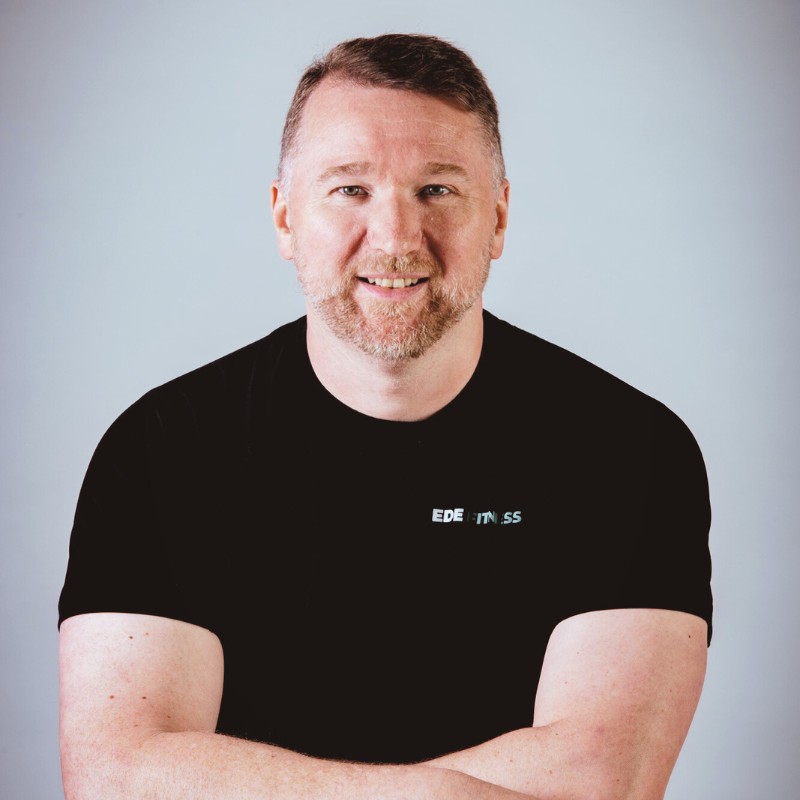
Rob Ede is a health-first personal trainer and Level 4 nutrition coach at Lightwater Leisure Centre.
Medical disclaimer: This article is for general information and education only and is not a substitute for personalised medical advice, diagnosis or treatment. I am a qualified personal trainer and nutrition coach, not a doctor. Always consult an appropriate healthcare professional before making significant changes to your exercise, nutrition or medication, particularly if you have a medical condition, are pregnant, or take prescription medication.
Related reading
What Does a Nutrition Coach Actually Do, and Are You Making the Most of Yours?, the nutrition side of this same feedback loop, and what it looks like when a client actually uses it.
Is a Personal Trainer Worth It After 50? Here's What You're Really Paying For, the honest case for supervision itself, with the evidence on adherence and outcomes.
Copyright © 2026 Rob Ede. You may quote brief excerpts from this article provided you include appropriate attribution and a link to the original. Please do not reproduce or republish the article in full without written permission.