The Professional Reality of Biofeedback and Beyond: Using Oura, Whoop, and Garmin for High-Performance Coaching
Most high-performing professionals treat their physical capability like a low-priority line item. They'll commission consultants, build roadmaps, and track KPIs for every business function. Then leave their own physiology running on guesswork and good intentions.
That's not a sustainable strategy. It's a liability.
You wouldn't make a major operational decision without reliable data in front of you. Yet most executives navigating the physical demands of midlife are doing exactly that, relying on subjective feelings, inconsistent effort, and the vague hope that being "reasonably active" is enough to hold things together.
It isn't. And by the time the consequences become obvious, they've usually been accumulating for years.
What Your Body Is Already Telling You
The professionals who perform best physically in their forties and fifties aren't necessarily training harder. They're training with better information.
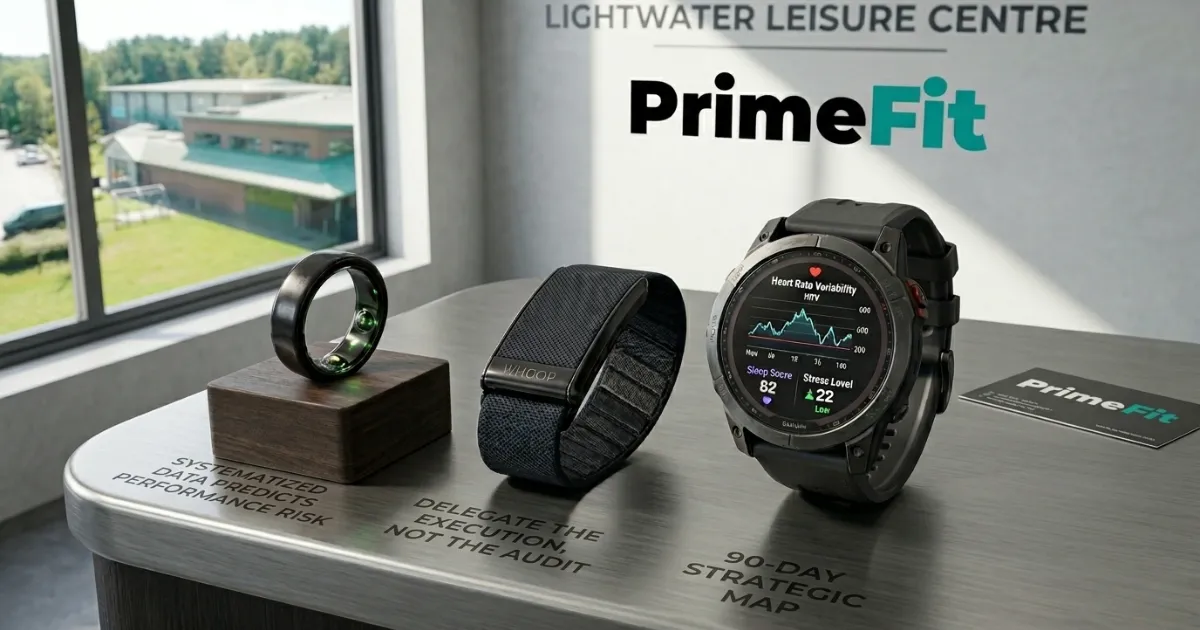
Wearable biofeedback devices such as the Oura Ring, Whoop, and Garmin's performance range have moved well beyond step-counting. Used properly, they give you a continuous, objective window into the physiological variables that directly govern your performance capacity. Heart rate variability, sleep architecture, resting heart rate trends, respiratory rate, and recovery scores aren't abstract wellness metrics. They're operational data points.
Heart rate variability in particular is one of the most reliable indicators of autonomic nervous system health. A sustained downward trend in your HRV doesn't just mean you're tired. It means your system is under load it isn't recovering from, whether that's training stress, work pressure, poor sleep quality, or nutritional deficit. Without tracking it, you wouldn't know until the consequences showed up in your performance, your mood, or eventually your health.
What the Data Actually Measures
Each platform has a distinct focus, and understanding the difference matters when you're using the data to inform coaching decisions.
The Oura Ring prioritises sleep and recovery. Its sleep staging data is among the most accurate available in consumer wearables, and its readiness score synthesises overnight recovery metrics into a daily performance indicator. For professionals whose sleep is frequently disrupted by travel, late work, or stress, this is where the most actionable insights tend to surface.
Whoop is built around strain and recovery as a continuous cycle. It quantifies the physiological cost of both training and daily activity, then measures whether your recovery is keeping pace. The result is a clear picture of whether you're accumulating a performance debt before it becomes a problem you can feel.
Garmin's performance range integrates training load, body battery, and lactate threshold estimates alongside GPS and workout data. For professionals who are already training with structure, Garmin provides the most granular feedback on whether the physical work you're putting in is producing the adaptation you're after.
Why Data Without Interpretation Is Just Noise
This is where most professionals stall. The devices generate data. The data sits in an app. The app offers generic suggestions. Nothing meaningfully changes.
Biofeedback becomes genuinely useful when someone with the expertise to interpret it is making decisions based on what it shows. That means adjusting training load when recovery scores indicate your system is under-resourced. It means identifying patterns between sleep quality and session performance. It means distinguishing between the productive stress of a well-designed training week and the unproductive stress of doing too much without adequate recovery.
At PrimeFit, based at Lightwater Leisure Centre in Surrey, biofeedback data from your existing devices can be integrated directly into your programme design. If your Oura readiness is low, we adjust. If your HRV trend is declining over several weeks, we look at why. The training adapts to your physiology in real time, rather than running on a fixed schedule that ignores what your body is actually doing.
The Compounding Advantage
For busy professionals over forty, this approach solves a specific problem. You have limited training time and high recovery demands from a pressured professional life. You cannot afford to spend sessions pushing hard when your system is under-resourced, and you cannot afford to under-train when the data shows you have capacity to build.
Getting that balance right consistently, over months and years, is what produces durable physical performance rather than cycles of progress and regression. It's the difference between managing your physiology and just reacting to it.
If you're ready to stop training on instinct and start using the data your body is already generating, the next step is a conversation.
Initial consultations take place at FieldHouse Coffee in Surrey. No commitment, no sales pitch. Just a clear look at where you are, what your data is telling you, and what a structured plan built around it looks like.